
Question 1Graphs of functions
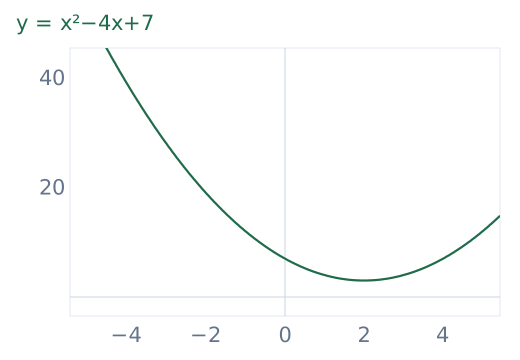
The curve y = x2 − 4x + 7 and the line y = kx + 1 meet at exactly one point. What are the possible values of k?
These are SummitPapers original questions, not official past paper questions. Official TMUA questions sorted by topic are on TMUA past papers by topic.
Covers: transformations of a graph, asymptotes and points of intersection, how many regions a graph divides the plane into, reading a graph of f or of its derivative.
Question 1Graphs of functions
Graphs of functions here means transformations, asymptotes and intersections, how many regions a graph divides the plane into, and reading a graph of f or of its derivative.
This is Section 1, on both papers in this set. Each question has five options. A paper is 20 questions in 75 minutes, with no calculator.
This note is written for SummitPapers. The official list of what can be examined is the specification, together with the Notes on Mathematics and, for Paper 2, the Notes on Logic and Proof.
y = f(x − a) shifts the graph of y = f(x) to the right by a. y = f(x) + a shifts it up by a. y = f(ax) stretches horizontally by factor 1/a. The order of two transformations is part of the answer.
Where f is increasing, f' is positive. A stationary point of f is a root of f'. The gradient of f at a point is the height of the graph of f', not the height of f.
f(x + 2) moves the graph left, not right. The sign inside the brackets is opposite to the direction of the shift.
A vertical asymptote is where the function is undefined. It is not a point where the graph crosses the axis.
This question is also in the list below, with the solution folded. It is opened here so the method is on the page before the other questions.
Answer: C. k = −4 ± 2√6
Worked solution. Set x2 − 4x + 7 = kx + 1, so x2 − (4 + k)x + 6 = 0. Exactly one intersection means the discriminant is zero: (4 + k)2 − 24 = 0, so 4 + k = ±√24 = ±2√6. Therefore k = −4 ± 2√6.
Why the other options look right. A keeps only the positive square root of 24. B keeps only the negative square root. D replaces √24 by √6 and drops the factor 2. E solves 4 + k = ±2√6 as k = 4 ± 2√6.
Paper 1 is Applications of Mathematical Knowledge. Calculators are not allowed.
Free · worked solution included
Answer: C. k = −4 ± 2√6
Worked solution. Set x2 − 4x + 7 = kx + 1, so x2 − (4 + k)x + 6 = 0. Exactly one intersection means the discriminant is zero: (4 + k)2 − 24 = 0, so 4 + k = ±√24 = ±2√6. Therefore k = −4 ± 2√6.
Why the other options look right. A keeps only the positive square root of 24. B keeps only the negative square root. D replaces √24 by √6 and drops the factor 2. E solves 4 + k = ±2√6 as k = 4 ± 2√6.
Free · worked solution included
Answer: D. I and II only
Worked solution. Let g(x) = f(x − 2). Rotational symmetry of g about (2, 0) means g(2 + t) + g(2 − t) = 0, so f(t) + f(−t) = 0, and conversely. Thus I is true. Symmetry of g about x = 2 means g(2 + t) = g(2 − t), so f(t) = f(−t), and conversely. Thus II is true. For III, f(x) = x2 is even, but f(x − 2) = (x − 2)2 gives 1 at x = 1 and 9 at x = −1, so it is not symmetric about the y-axis. Thus III is false. Only I and II are true.
Why the other options look right. A thinks that translating the graph 2 units to the right destroys the symmetry of f, so it rejects all three statements. B drops the reflection in the line x = 2, which is exactly evenness of f. C drops the half-turn about (2, 0), which is exactly oddness of f. E includes III, but f(x) = x2 is a counterexample.
Free · worked solution included
Answer: A. 0.001
Worked solution. A translation by 3 in the positive y-direction gives y = log base 10 of x, plus 3, which is log base 10 of (1000x). A stretch of factor k parallel to the x-axis replaces x by x/k, giving y = log base 10 of (x/k). These agree when 1/k = 1000, so k = 0.001, which is option A.
Why the other options look right. E is 1000, from writing the stretch as log base 10 of (kx) instead of log base 10 of (x/k), so that kx = 1000x. B is −3, from solving log base 10 of x − log base 10 of k = log base 10 of x + 3 to get log base 10 of k = −3 and reporting log k instead of k. C is 1/3, from writing log base 10 of x + 3 as log base 10 of (3x), so x/k = 3x. D is the translation distance 3 itself, mistaken for the stretch factor.
Free · correct letter only
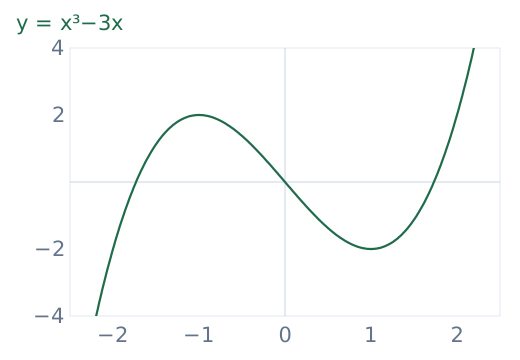
Answer: E. 22/27 < k < 1
The worked solution is part of the full bank. The question and the correct letter are free. Unlock the full bank
Free · correct letter only
Answer: B. y = −(1/2)x2 + 4x − 5
The worked solution is part of the full bank. The question and the correct letter are free. Unlock the full bank
Free · correct letter only
Answer: D. 5
The worked solution is part of the full bank. The question and the correct letter are free. Unlock the full bank
Free · correct letter only
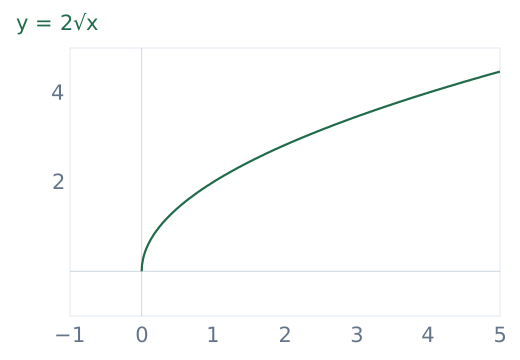
Answer: C. 0 < m < 1
The worked solution is part of the full bank. The question and the correct letter are free. Unlock the full bank
Free · correct letter only
Answer: C. 16
The worked solution is part of the full bank. The question and the correct letter are free. Unlock the full bank
Free · correct letter only
Answer: C. 5
The worked solution is part of the full bank. The question and the correct letter are free. Unlock the full bank
Free · correct letter only
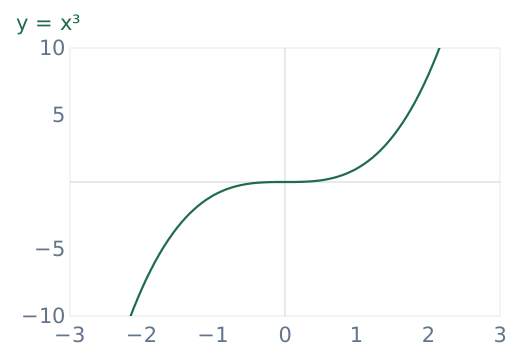
Answer: E. I and III only
The worked solution is part of the full bank. The question and the correct letter are free. Unlock the full bank
Free · correct letter only
Answer: A. 1 < q ≤ 3
The worked solution is part of the full bank. The question and the correct letter are free. Unlock the full bank
Free · correct letter only
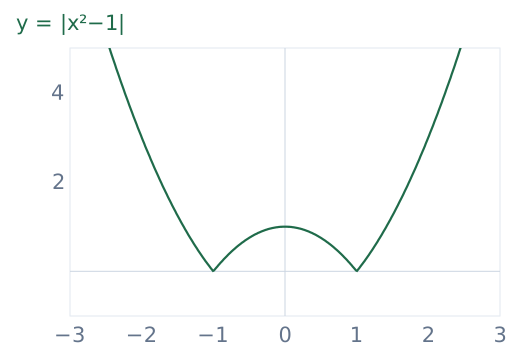
Answer: D. 4
The worked solution is part of the full bank. The question and the correct letter are free. Unlock the full bank
Free · correct letter only
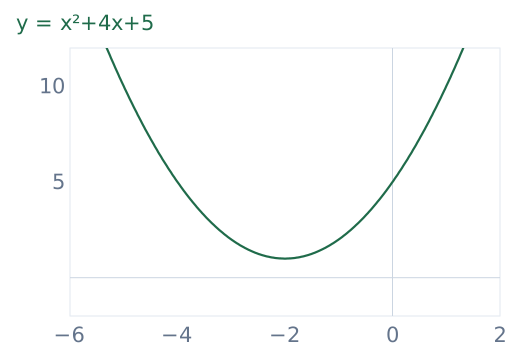
Answer: A. 0 < m < 8
The worked solution is part of the full bank. The question and the correct letter are free. Unlock the full bank
Free · correct letter only
Answer: B. 8
The worked solution is part of the full bank. The question and the correct letter are free. Unlock the full bank
Free · correct letter only
Answer: D. 9
The worked solution is part of the full bank. The question and the correct letter are free. Unlock the full bank
Free · correct letter only
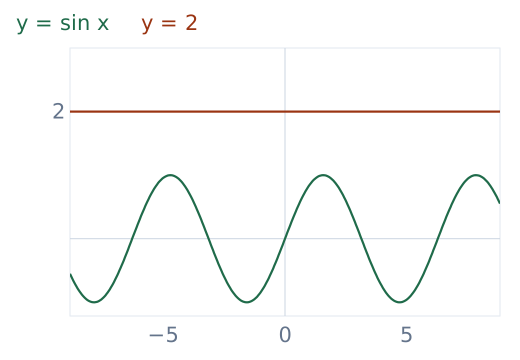
Answer: D. y = 4 − sin(x − π/6)
The worked solution is part of the full bank. The question and the correct letter are free. Unlock the full bank
Free · worked solution included
Answer: B. y = f(x − 2)
Worked solution. A translation of a units in the positive x-direction replaces x by x − a. Here a = 2, so the equation is y = f(x − 2). A point that was at x = 0 on the original graph is now at x = 2.
Why the other options look right. A replaces x by x + 2, which moves the graph 2 units in the negative x-direction. C moves the graph 2 units up. D moves it 2 units down. E stretches the graph vertically by a factor of 2 and does not translate it.
Free · correct letter only
Answer: A. (3, 2)
The worked solution is part of the full bank. The question and the correct letter are free. Unlock the full bank
Free · correct letter only
Answer: A. (−5, 11)
The worked solution is part of the full bank. The question and the correct letter are free. Unlock the full bank
Free · correct letter only
Answer: A. (4, 0)
The worked solution is part of the full bank. The question and the correct letter are free. Unlock the full bank
Free · correct letter only
Answer: C. (1, 3)
The worked solution is part of the full bank. The question and the correct letter are free. Unlock the full bank
Free · correct letter only
Answer: A. (0, 4)
The worked solution is part of the full bank. The question and the correct letter are free. Unlock the full bank
Free · correct letter only
Answer: E. (3/2, 6)
The worked solution is part of the full bank. The question and the correct letter are free. Unlock the full bank
Free · correct letter only
Answer: C. (4, 10)
The worked solution is part of the full bank. The question and the correct letter are free. Unlock the full bank
Free · correct letter only
Answer: C. 21
The worked solution is part of the full bank. The question and the correct letter are free. Unlock the full bank
Free · correct letter only
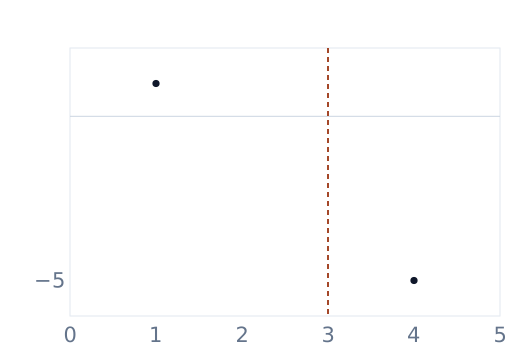
Answer: A. y = 2x2 − 12x + 11
The worked solution is part of the full bank. The question and the correct letter are free. Unlock the full bank
Free · correct letter only
Answer: C. 2
The worked solution is part of the full bank. The question and the correct letter are free. Unlock the full bank
Free · correct letter only
Answer: B. I and III only
The worked solution is part of the full bank. The question and the correct letter are free. Unlock the full bank
Free · correct letter only
Answer: A. (5, √6)
The worked solution is part of the full bank. The question and the correct letter are free. Unlock the full bank
Free · correct letter only
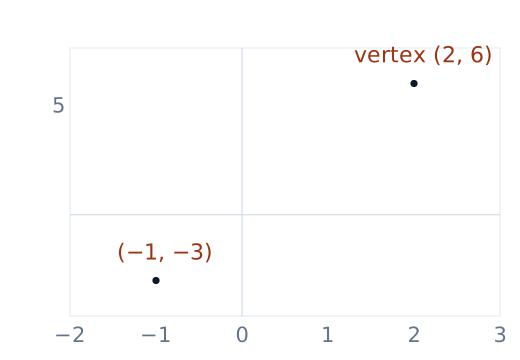
Answer: D. −x2 + 4x + 2
The worked solution is part of the full bank. The question and the correct letter are free. Unlock the full bank
Free · correct letter only
Answer: A. 5/4
The worked solution is part of the full bank. The question and the correct letter are free. Unlock the full bank
Free · correct letter only
Answer: B. It has the line y = x as a line of symmetry, but neither coordinate axis.
The worked solution is part of the full bank. The question and the correct letter are free. Unlock the full bank
Free · correct letter only
Answer: E. 7
The worked solution is part of the full bank. The question and the correct letter are free. Unlock the full bank
Free · correct letter only
Answer: D. 6
The worked solution is part of the full bank. The question and the correct letter are free. Unlock the full bank
Free · correct letter only
Answer: D. the cube root of 4
The worked solution is part of the full bank. The question and the correct letter are free. Unlock the full bank
Free · correct letter only
Answer: E. 2
The worked solution is part of the full bank. The question and the correct letter are free. Unlock the full bank
Free · correct letter only
Answer: E. a stretch parallel to the x-axis, followed by a stretch parallel to the y-axis
The worked solution is part of the full bank. The question and the correct letter are free. Unlock the full bank
Free · correct letter only
Answer: C. 2
The worked solution is part of the full bank. The question and the correct letter are free. Unlock the full bank
Free · correct letter only
Answer: C. y ≤ −1 or y ≥ 1
The worked solution is part of the full bank. The question and the correct letter are free. Unlock the full bank
Free · correct letter only
Answer: A. 2
The worked solution is part of the full bank. The question and the correct letter are free. Unlock the full bank
Free · correct letter only
Answer: D. 2
The worked solution is part of the full bank. The question and the correct letter are free. Unlock the full bank
Free · correct letter only
Answer: B. The graph has asymptotes x = 2 and y = x − 3.
The worked solution is part of the full bank. The question and the correct letter are free. Unlock the full bank
Free · correct letter only
Answer: B. y = 6 − f(−x)
The worked solution is part of the full bank. The question and the correct letter are free. Unlock the full bank
Free · correct letter only
Answer: A. 4/9
The worked solution is part of the full bank. The question and the correct letter are free. Unlock the full bank
Free · correct letter only
Answer: C. 7
The worked solution is part of the full bank. The question and the correct letter are free. Unlock the full bank
Free · correct letter only
Answer: D. 2
The worked solution is part of the full bank. The question and the correct letter are free. Unlock the full bank
Paper 2 is Mathematical Reasoning. It can test this same topic. Argument, proof, and identifying errors are the topics that appear on Paper 2 only.
Free · worked solution included
Answer: C. y = 0 when x = π/2.
Worked solution. At x = π/2, cos(π/2) = 0, so y = 3−π/2 × 0 = 0. The other statements fail. The factor 3−x is not periodic, so y is not periodic. Both 3−x and cos2(x) are nonnegative, so y is never negative. At x = 0, y = 1, but at x = −2π, cos(−2π) = 1 and 32π > 1, so y exceeds 1 and 1 is not the greatest value. As x → ∞, 3−x → 0, so y → 0 rather than 1.
Why the other options look right. A would hold for cos2(x) alone, but multiplication by 3−x destroys the period. B treats 3−x as negative when x is positive, confusing a negative exponent with a negative value, but 3−x > 0 for every x and cos2(x) ≥ 0. D evaluates y at x = 0 and ignores the larger values for negative x, such as y = 32π at x = −2π. E uses the limit of 3−x × 1 as if the exponential tended to 1.
Free · worked solution included
Answer: D. f(x − 2) > 0 for 3 < x < 7
Worked solution. If 3 < x < 7, then 1 < x − 2 < 5, so f(x − 2) > 0; this holds for every such f. The other statements need not hold. For f(x) = (x − 1)(5 − x)(x + 1), which is positive on 1 < x < 5, f'(x) = (6 − 2x)(x + 1) + (x − 1)(5 − x), so f'(3) = 0 + 4 = 4. The integral from 1 to 5 of f'(x) dx equals f(5) − f(1) = 0, which is never positive. For f(x) = (x − 1)(5 − x), f(−x) = −(x + 1)(x + 5), which is negative for 1 < x < 5. For f(x) = −(x − 3)4 + 3(x − 3)2 + 4, write t = x − 3: f = (4 − t2)(t2 + 1) is zero at t = ±2 and positive between, and f' = 2t(3 − 2t2) vanishes at t = 0 and t = ±√(3/2), three points of (1, 5). The statement that must be true is f(x − 2) > 0 for 3 < x < 7.
Why the other options look right. A assumes the graph is symmetric about x = 3, but f(x) = (x − 1)(5 − x)(x + 1) has f'(3) = 4. B forgets that the integral of f' from 1 to 5 is f(5) − f(1) = 0, whatever the shape between the roots. C reflects the interval the wrong way: f(−x) > 0 is guaranteed only for −5 < x < −1, and for f(x) = (x − 1)(5 − x) it is negative on 1 < x < 5. E relies on Rolle's theorem, which guarantees at least one zero of f', but f(x) = −(x − 3)4 + 3(x − 3)2 + 4 has three.
Free · worked solution included
Answer: A. 4, 2, 4, 3
Worked solution. A quartic has at most three turning points. If the leading coefficient is positive and the two local minima have different heights, the local maximum lies above both of them. As the horizontal level rises, the number of distinct intersections runs through 0, 1, 2, 3, 4, 3, 2, hitting the odd values only at the turning levels. After the four-root band, the count falls through 3 to the two-root region above the local maximum, and it cannot return to 4. If the minima have equal heights the counts are 0, 2, 4, 3, 2, and with only one minimum they are 0, 1, 2. In every case the levels with four intersections form a single interval, so 4 cannot reappear after a 2. The sequence 4, 2, 4, 3 is impossible.
Why the other options look right. B is the region below the graph, then the lower minimum, then the two-root band, then the four-root band. C is the two-root band, the four-root band, the local maximum, then the region above it. D is the lower minimum, the two-root band, the four-root band, then the local maximum. E skips the turning levels: below the graph, between the minima, in the four-root band, then above the local maximum.
Free · worked solution included
Answer: B. II only
Worked solution. The vertex has x-coordinate −b/(2a) = 2, so b = −4a and ab = −4a2, which is negative for every a ≠ 0. So II must be true. The vertex value is c − b2/(4a) = c − 4a = −3, so c = 4a − 3. Meeting the y-axis below the x-axis means c < 0, that is 4a − 3 < 0, so a < 3/4 with a ≠ 0. Both signs of a are possible. a = 1/2 gives y = (1/2)x2 − 2x − 1, with vertex (2, −3) and c = −1, so III is false. a = −1 gives y = −x2 + 4x − 7, with vertex (2, −3) and c = −7, so I is false. Only II must be true, which is option B.
Why the other options look right. A overlooks that the vertex condition −b/(2a) = 2 forces b = −4a, so ab = −4a2 < 0 always. C assumes a vertex below the x-axis must be a minimum point, so a > 0; but a = −1 gives y = −x2 + 4x − 7, with vertex (2, −3) and y-intercept −7. D assumes the vertex is the highest point, so the y-intercept would lie below −3; but a = 1/2 gives y = (1/2)x2 − 2x − 1, with vertex (2, −3) and y-intercept −1. E accepts I and III as well, but they cannot both hold, since c = 4a − 3 < −3 needs a < 0; the two examples above refute I and III separately.
Free · worked solution included
Answer: E. I, II and III
Worked solution. A half-turn about (a, b) sends the point (a + t, y) to (a − t, 2b − y). The graph is unchanged exactly when every point (a + t, f(a + t)) is sent to a point of the graph, that is f(a − t) = 2b − f(a + t) for every t. This is condition I. Putting x = a + t in II gives f(a − t) = 2b − f(a + t), so II is the same condition. For III, g(−x) = −g(x) means f(a − x) − b = −(f(a + x) − b), which rearranges to f(a + x) + f(a − x) = 2b, again condition I. All three conditions are necessary and sufficient.
Why the other options look right. A accepts only the defining condition I and rejects both rewritings, although II is I with x replaced by a + x and III is I after moving the centre to the origin. B rejects III, overlooking that moving the centre (a, b) to the origin turns half-turn symmetry into the odd-function condition. C rejects II, overlooking that 2a − x and x lie the same distance either side of a. D rejects I, which is the definition of the symmetry written with the points a + x and a − x.
Free · correct letter only
Answer: B. II only
The worked solution is part of the full bank. The question and the correct letter are free. Unlock the full bank
Free · correct letter only
Answer: E. f(x) = f(x + 3/2) for all x
The worked solution is part of the full bank. The question and the correct letter are free. Unlock the full bank
Free · correct letter only
Answer: E. y > 1 for every x with |x| > 2.
The worked solution is part of the full bank. The question and the correct letter are free. Unlock the full bank
Free · correct letter only
Answer: D. 0, 2, 3, 4
The worked solution is part of the full bank. The question and the correct letter are free. Unlock the full bank
Free · correct letter only
Answer: C. (sin x)tan x tends to 1 as x tends to π/2 from below
The worked solution is part of the full bank. The question and the correct letter are free. Unlock the full bank
Free · correct letter only
Answer: D. It is the x-axis, the y-axis and the line y = −x.
The worked solution is part of the full bank. The question and the correct letter are free. Unlock the full bank
Free · correct letter only
Answer: A. It is the part of the line y = 3 with x > 0, except the point (1, 3).
The worked solution is part of the full bank. The question and the correct letter are free. Unlock the full bank
Free · correct letter only
Answer: D. k = −1 or k = −3/4
The worked solution is part of the full bank. The question and the correct letter are free. Unlock the full bank
Free · correct letter only
Answer: C. 7
The worked solution is part of the full bank. The question and the correct letter are free. Unlock the full bank
Free · correct letter only
Answer: E. 2
The worked solution is part of the full bank. The question and the correct letter are free. Unlock the full bank
Free · correct letter only
Answer: B. 3
The worked solution is part of the full bank. The question and the correct letter are free. Unlock the full bank
Free · correct letter only
Answer: D. 5
The worked solution is part of the full bank. The question and the correct letter are free. Unlock the full bank
Free · correct letter only
Answer: A. 3
The worked solution is part of the full bank. The question and the correct letter are free. Unlock the full bank
Free · correct letter only
Answer: A. (3, 2)
The worked solution is part of the full bank. The question and the correct letter are free. Unlock the full bank
Free · correct letter only
Answer: A. 8
The worked solution is part of the full bank. The question and the correct letter are free. Unlock the full bank
Free · correct letter only
Answer: B. 1/4 ≤ f(x) < 1
The worked solution is part of the full bank. The question and the correct letter are free. Unlock the full bank
Free · correct letter only
Answer: B. 6
The worked solution is part of the full bank. The question and the correct letter are free. Unlock the full bank
Free · correct letter only
Answer: A. 2 + √(x − 3), x ≥ 3
The worked solution is part of the full bank. The question and the correct letter are free. Unlock the full bank
Free · correct letter only
Answer: B. 3
The worked solution is part of the full bank. The question and the correct letter are free. Unlock the full bank
Free · correct letter only
Answer: E. exactly four
The worked solution is part of the full bank. The question and the correct letter are free. Unlock the full bank
Free · correct letter only
Answer: A. 9
The worked solution is part of the full bank. The question and the correct letter are free. Unlock the full bank