
Question 1Differentiation
TMUA Differentiation — Practice Questions by Topic
These are SummitPapers original questions, not official past paper questions. Official TMUA questions sorted by topic are on TMUA past papers by topic.
- MM6Differentiation
- 99 questions69 on Paper 1 · 30 on Paper 2
- 9 free solutionsThe rest show the correct letter only
Covers: stationary points and turning values, tangents and normals, increasing and decreasing functions, optimisation, limits used to find a gradient.
What this topic tests
Differentiation here means stationary points, tangents and normals, increasing and decreasing functions, optimisation, and a limit used to find a gradient.
How it is assessed
This is Section 1, on both papers in this set. Each question has five options. A paper is 20 questions in 75 minutes, with no calculator.
This note is written for SummitPapers. The official list of what can be examined is the specification, together with the Notes on Mathematics and, for Paper 2, the Notes on Logic and Proof.
Key methods
A stationary point
A stationary point has derivative zero. The first derivative changing from positive to negative, or the second derivative being negative, distinguishes a local maximum from a local minimum. A zero derivative alone does not say which.
Tangent and normal
The gradient of the tangent at a point is the derivative there. The normal is perpendicular to that tangent, so its gradient is the negative reciprocal when the tangent is not horizontal.
Common mistakes
The derivative of a product
The derivative of uv is u'v + uv', not u'v'. The derivative of u/v is (u'v − uv') / v².
A horizontal tangent treated as undefined
A zero derivative is a horizontal tangent. The normal is then vertical. It is not “no tangent”.
Worked example
This question is also in the list below, with the solution folded. It is opened here so the method is on the page before the other questions.
Given y = 4x³ − x, what is the value of dy/dx when x = 1?
Answer: C. 11
Worked solution. Differentiate term by term: dy/dx = 12x² − 1. At x = 1 this is 12 − 1 = 11.
Why the other options look right. A substitutes x = 1 into 4x − 1 and never differentiates the cube. B reads off the coefficient 4 of x³ instead of differentiating and substituting x = 1. D is 12x² at x = 1, with the −1 omitted. E differentiates −x as +1, giving 12 + 1.
Paper 1 questions
Paper 1 is Applications of Mathematical Knowledge. Calculators are not allowed.
Q1. Evaluate the limit, as x approaches 0, of (1 − cos(6x)) / x2.
Free · worked solution included
Answer and worked solution
Answer: D. 18
Worked solution. Use the identity 1 − cos(6x) = 2 sin2(3x). Then (1 − cos(6x))/x2 = 2 (sin(3x)/x)2 = 18 (sin(3x)/(3x))2. As x approaches 0, sin(3x)/(3x) approaches 1, so the limit is 18.
Why the other options look right. A uses 1 − cos u ≈ u²/2 with u = 6x but writes (6x)² as 6x², so the limit is 6/2 = 3. B writes 1 − cos(6x) = 2 sin²(3x) but forgets to square sin(3x)/x, so it gets 2 × 3 = 6. C drops the factor 2 in the identity 1 − cos(6x) = 2 sin2(3x) and keeps only the limit of sin2(3x)/x2, which is 9. E uses 1 − cos u ~ u2 with u = 6x, giving 36 rather than half of that.
Q2. The curve y = x3 − 6x2 − 288x + 4 has two stationary points. What is the greater of their x-coordinates?
Free · worked solution included
Answer and worked solution
Answer: E. 12
Worked solution. Differentiate: dy/dx = 3x2 − 12x − 288 = 3(x2 − 4x − 96) = 3(x − 12)(x + 8). The stationary points are at x = 12 and x = −8, and the greater x-coordinate is 12.
Why the other options look right. A applies the quadratic formula to x2 − 4x − 96 = 0 but does not divide by 2a, giving 4 + 20 = 24. B reports the smaller stationary x-coordinate, −8, instead of the greater one. C reports the product of the roots of x2 − 4x − 96 = 0, which is −96, instead of the greater root. D reports the sum of the roots of x2 − 4x − 96 = 0, −b/a = 4, instead of the greater root.
Q3. A particle moves on a straight line. Its displacement in metres at time t seconds, for t ≥ 0, is s(t) = t3 − 3t2 − 24t. Find all the times at which the particle is instantaneously at rest.
Free · worked solution included
Answer and worked solution
Answer: A. t = 4 only
Worked solution. The particle is at rest when the velocity is zero. Differentiate to get v(t) = 3t2 − 6t − 24 = 3(t2 − 2t − 8) = 3(t − 4)(t + 2). So v(t) = 0 at t = 4 and at t = −2. The motion is only defined for t ≥ 0, so t = −2 is rejected. The particle is instantaneously at rest at t = 4 only.
Why the other options look right. B solves v(t) = 0 correctly but keeps t = −2, which is outside t ≥ 0. C factors t2 − 2t − 8 as (t − 2)(t + 4), with the signs swapped, which gives t = 2 or t = −4, and then keeps only t = 2. D sets the acceleration 6t − 6 equal to zero instead of the velocity, giving t = 1. E sets the displacement equal to zero: t(t2 − 3t − 24) = 0 gives t = 0 or t = (3 ± √105)/2, and keeping the non-negative values gives t = 0 and t = (3 + √105)/2.
Q4. For x > 0, what is the maximum value of f(x) = x2 e−x?
Free · worked solution included
Answer and worked solution
Answer: A. 4/e2
Worked solution. The product rule gives f'(x) = 2x e−x − x2 e−x = x(2 − x) e−x. For x > 0 the only stationary point is x = 2. The factor x(2 − x) changes from positive to negative there, and f(x) tends to 0 at both ends of x > 0, so this stationary point is the maximum. Its value is f(2) = 4 e−2 = 4/e2.
Why the other options look right. B is the value of x e−x at x = 2, which drops one factor of x. C replaces e−2 by e−1. D keeps only the factor e−2. E evaluates x2 e−x at x = 1, the stationary point of x e−x.
Q5. Find the second derivative of f(x) = (x + 1)e3x.
Free · worked solution included
Answer and worked solution
Answer: A. (9x + 15)e3x
Worked solution. The product rule gives f'(x) = e3x + 3(x + 1)e3x = (3x + 4)e3x. Differentiating again, f''(x) = 3 e3x + 3(3x + 4)e3x = (3 + 9x + 12)e3x = (9x + 15)e3x.
Why the other options look right. B keeps only the chain-rule term 3(3x + 4)e3x and drops the derivative of 3x + 4. C stops after one differentiation and reports f'(x) = (3x + 4)e3x. D multiplies only one of the two product terms by 3, giving (3 + 3x + 4)e3x. E keeps the correct bracket but replaces e3x by ex.
Q6. Find dy/dx if x2 + y2 = cos x.
Free · worked solution included
Answer and worked solution
Answer: E. −(2x + sin x)/(2y)
Worked solution. Differentiate both sides with respect to x. The left side gives 2x + 2y dy/dx, and the right side gives −sin x. So 2y dy/dx = −sin x − 2x, and dy/dx = −(2x + sin x)/(2y).
Why the other options look right. A reverses the overall sign. B differentiates cos x to sin x rather than to −sin x. C cancels the 2 in 2x against the 2 in the denominator 2y but leaves sin x unchanged, turning −(2x + sin x)/(2y) into −(x + sin x)/y. D omits the derivative of x2.
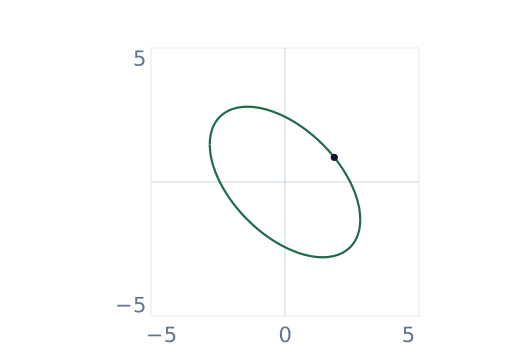
Q7. The curve x2 + xy + y2 = 7 passes through (2, 1). What is dy/dx at that point?
Free · worked solution included
Answer and worked solution
Answer: C. −5/4
Worked solution. Differentiate both sides with respect to x. The derivative of x2 is 2x, the derivative of xy is y + x dy/dx, and the derivative of y2 is 2y dy/dx. So 2x + y + x dy/dx + 2y dy/dx = 0, and dy/dx = −(2x + y)/(x + 2y). At (2, 1) this is −(4 + 1)/(2 + 2) = −5/4. The point is on the curve because 4 + 2 + 1 = 7.
Why the other options look right. A differentiates xy as dy/dx alone, dropping both the factor x and the term y, so 2x + dy/dx + 2y dy/dx = 0 and dy/dx = −2x/(1 + 2y) = −4/3 at (2, 1). B differentiates xy as x dy/dx only, dropping the term y, so 2x + x dy/dx + 2y dy/dx = 0 and dy/dx = −2x/(x + 2y) = −4/4 = −1. D differentiates xy as y only, dropping the term x dy/dx, so 2x + y + 2y dy/dx = 0 and dy/dx = −(2x + y)/(2y) = −5/2. E moves 2x + y to the other side without changing its sign, giving dy/dx = (2x + y)/(x + 2y) = 5/4.
Q8. For x > 0, let y = x3x. Which expression is equal to dy/dx?
Free · worked solution included
Answer and worked solution
Answer: A. 3 x3x (1 + ln x)
Worked solution. Write y = e3x ln x. Differentiating the exponent gives 3 ln x + 3x × (1/x) = 3 ln x + 3 = 3(1 + ln x). Therefore dy/dx = 3 x3x (1 + ln x).
Why the other options look right. B drops the factor 3 that comes from the exponent 3x. C keeps that factor but drops the term 3x × (1/x) = 3 that comes from differentiating ln x in the product 3x ln x. D treats the exponent 3x as a constant and applies the ordinary power rule, giving 3x × x3x − 1 = 3 x3x. E differentiates x ln x as ln x + 1/x, forgetting to multiply 1/x by x, giving 3 x3x (ln x + 1/x).
Q9. For x > 0, which expression is the derivative of x3 − 4x2 + 6x√x with respect to x?
Free · correct letter only
Answer
Answer: E. 3x2 − 8x + 9√x
The worked solution is part of the full bank. The question and the correct letter are free. Unlock the full bank
Q10. A curve is given parametrically by x = t2 − 4t and y = t3 − 3t2, with t real. At how many points does this curve have a horizontal tangent?
Free · correct letter only
Answer
Answer: B. 1
The worked solution is part of the full bank. The question and the correct letter are free. Unlock the full bank
Q11. The polynomial f(x) = x3 + px2 + qx + r satisfies f(1) = 10, f'(−1) = 7 and f''(0) = 2p. What is p + q + r?
Free · correct letter only
Answer
Answer: B. 9
The worked solution is part of the full bank. The question and the correct letter are free. Unlock the full bank
Q12. How many distinct real solutions does (x3 − 3x)2 = 1 have?
Free · correct letter only
Answer
Answer: E. 6
The worked solution is part of the full bank. The question and the correct letter are free. Unlock the full bank
Q13. For a positive number a, let I(a) = ∫ from 0 to a of (12 − 3x2) dx. For which a is dI/da = 0?
Free · correct letter only
Answer
Answer: A. 2
The worked solution is part of the full bank. The question and the correct letter are free. Unlock the full bank
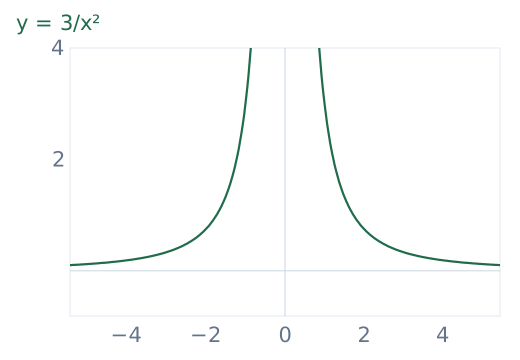
Q14. The normal to the curve y = 3/x2 at the point where x = 1 meets the coordinate axes at P and Q. Find the distance PQ.
Free · correct letter only
Answer
Answer: E. 17√37 / 6
The worked solution is part of the full bank. The question and the correct letter are free. Unlock the full bank
Q15. An open-top box has a rectangular base whose length is twice its width. Its volume is 36 cm3. What is the minimum possible surface area of the box?
Free · correct letter only
Answer
Answer: A. 54 cm2
The worked solution is part of the full bank. The question and the correct letter are free. Unlock the full bank
Q16. The function f is given by f(x) = (x3/2 − 2)2 / x for x > 0. What is the value of f''(1)?
Free · correct letter only
Answer
Answer: D. 11
The worked solution is part of the full bank. The question and the correct letter are free. Unlock the full bank
Q17. The curve C has equation y = x3 − p x2 + p2, where p is real. The tangent to C at the point where x = 2 meets the y-axis at (0, c). What is the least possible value of c as p varies?
Free · correct letter only
Answer
Answer: D. −20
The worked solution is part of the full bank. The question and the correct letter are free. Unlock the full bank
Q18. A point P lies on the parabola y = x² + 1. What is the minimum possible distance from P to the point (0, 4)?
Free · correct letter only
Answer
Answer: A. √11/2
The worked solution is part of the full bank. The question and the correct letter are free. Unlock the full bank
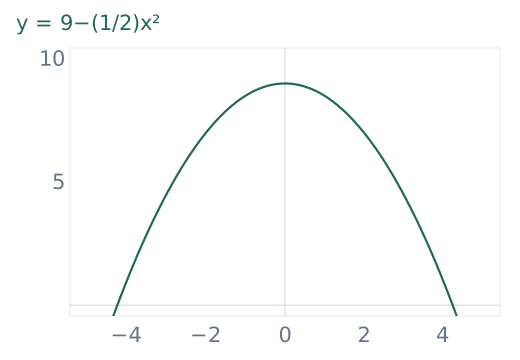
Q19. The line y = mx + 2, where m > 0, is normal to the curve y = 9 − (1/2)x2 at the point (p, q). What is p?
Free · correct letter only
Answer
Answer: D. 2√3
The worked solution is part of the full bank. The question and the correct letter are free. Unlock the full bank
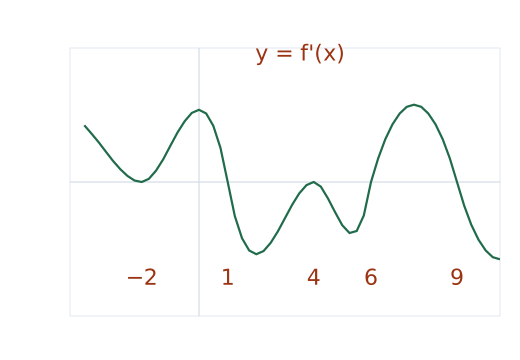
Q20. The derivative f' is continuous, and f'(x) = 0 only at the five points described here. At x = −2 the graph of f' touches the x-axis, and f' is positive on both sides. At x = 1, f' changes from positive to negative. At x = 4 the graph of f' touches the x-axis, and f' is negative on both sides. At x = 6, f' changes from negative to positive. At x = 9, f' changes from positive to negative. How many local maxima does f have?
Free · correct letter only
Answer
Answer: B. 2
The worked solution is part of the full bank. The question and the correct letter are free. Unlock the full bank
Q21. A curve has equation y = (x − q)²(2x + 1). The gradient at x = 1 depends on q. Which value of q minimises that gradient?
Free · correct letter only
Answer
Answer: B. 5/2
The worked solution is part of the full bank. The question and the correct letter are free. Unlock the full bank
Q22. For x > 0, what is the derivative of (x3 − 7x2)/(2x√x)?
Free · correct letter only
Answer
Answer: C. (3x − 7)/(4√x)
The worked solution is part of the full bank. The question and the correct letter are free. Unlock the full bank
Q23. Let f(x) = √x (4x2 − 3x + 1). For what fraction of the interval 0 < x < 1 is f decreasing?
Free · correct letter only
Answer
Answer: A. 1/20
The worked solution is part of the full bank. The question and the correct letter are free. Unlock the full bank
Q24. The curve y = x³ − 3x has a tangent of gradient 9 at the point where x = a, with a > 0. What is the y-intercept of this tangent?
Free · correct letter only
Answer
Answer: B. −16
The worked solution is part of the full bank. The question and the correct letter are free. Unlock the full bank
Q25. The function f satisfies f''(x) = a for every x, f(0) = 4 and f(1) = 0, and the integral of f from 0 to 1 equals 1. Find a.
Free · correct letter only
Answer
Answer: E. 12
The worked solution is part of the full bank. The question and the correct letter are free. Unlock the full bank
Q26. For each real m, let y = 2x2 − 2mx + (3/2)m2 + 6m + 4. Among all points on all of these curves, the one with the smallest y-coordinate is (a, b). Find a + b.
Free · correct letter only
Answer
Answer: E. −13/2
The worked solution is part of the full bank. The question and the correct letter are free. Unlock the full bank
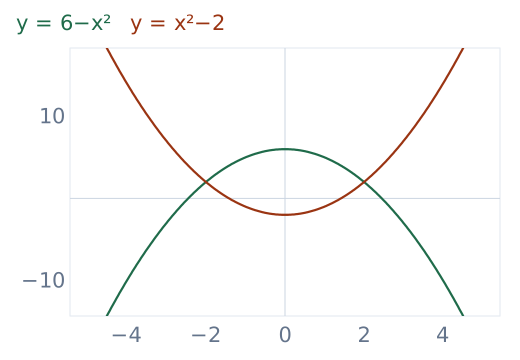
Q27. A rectangle with sides parallel to the axes sits in the region between y = 6 − x2 and y = x2 − 2. What is the greatest possible area of the rectangle?
Free · correct letter only
Answer
Answer: C. 64√3/9
The worked solution is part of the full bank. The question and the correct letter are free. Unlock the full bank
Q28. The equation x³ − 12x + b = 0 has three distinct real roots, exactly two of which are positive. What is the complete range of possible values of b?
Free · correct letter only
Answer
Answer: E. 0 < b < 16
The worked solution is part of the full bank. The question and the correct letter are free. Unlock the full bank
Q29. Let f(x) = x² − 4x + 7. What are the coordinates of the turning point of y = 1 − 2f(x − 2)?
Free · correct letter only
Answer
Answer: A. (4, −5)
The worked solution is part of the full bank. The question and the correct letter are free. Unlock the full bank
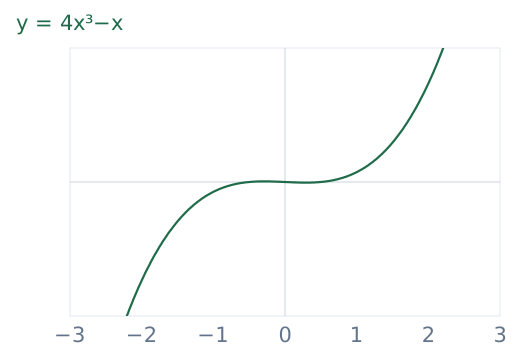
Q30. Given y = 4x³ − x, what is the value of dy/dx when x = 1?
Free · worked solution included
Answer and worked solution
Answer: C. 11
Worked solution. Differentiate term by term: dy/dx = 12x² − 1. At x = 1 this is 12 − 1 = 11.
Why the other options look right. A substitutes x = 1 into 4x − 1 and never differentiates the cube. B reads off the coefficient 4 of x³ instead of differentiating and substituting x = 1. D is 12x² at x = 1, with the −1 omitted. E differentiates −x as +1, giving 12 + 1.
Q31. Starting from f1(x) = 3x, each following function is 3x times the derivative of the function before it. Find f1(x) + f2(x) + … + f10(x).
Free · correct letter only
Answer
Answer: B. (3x/2)(310 − 1)
The worked solution is part of the full bank. The question and the correct letter are free. Unlock the full bank
Q32. For x > 0, the tangent to y = ln x at x = a passes through the origin. Find a.
Free · correct letter only
Answer
Answer: D. e
The worked solution is part of the full bank. The question and the correct letter are free. Unlock the full bank
Q33. How many distinct real roots does the equation x5 − 5x3 − 20x + 60 = 0 have?
Free · correct letter only
Answer
Answer: A. 1
The worked solution is part of the full bank. The question and the correct letter are free. Unlock the full bank
Q34. Find the x-coordinate of the local maximum of the curve y = 2x³ − 3x² − 12x + 5.
Free · correct letter only
Answer
Answer: E. −1
The worked solution is part of the full bank. The question and the correct letter are free. Unlock the full bank
Q35. The curve y = x³ + 3x² − 189x + 1 has a local maximum at which value of x?
Free · correct letter only
Answer
Answer: A. x = −9
The worked solution is part of the full bank. The question and the correct letter are free. Unlock the full bank
Q36. The curve y = 2x³ + 3x² − 36x + 5 has a local maximum. At what value of x does it occur?
Free · correct letter only
Answer
Answer: A. x = −3
The worked solution is part of the full bank. The question and the correct letter are free. Unlock the full bank
Q37. Let f(x) = x² + 6x + 10. Find the turning point of y = 2f(x − 1) + 3.
Free · correct letter only
Answer
Answer: A. (−2, 5)
The worked solution is part of the full bank. The question and the correct letter are free. Unlock the full bank
Q38. The curve y = x³ + 6x² − 231x + 5 has a local maximum at x equal to
Free · correct letter only
Answer
Answer: C. −11
The worked solution is part of the full bank. The question and the correct letter are free. Unlock the full bank
Q39. At which value of x does y = x³ − 6x² − 135x + 2 have a local maximum?
Free · correct letter only
Answer
Answer: B. x = −5
The worked solution is part of the full bank. The question and the correct letter are free. Unlock the full bank
Q40. At which value of x does the curve y = x³ − 12x² − 60x + 1 have a local maximum?
Free · correct letter only
Answer
Answer: B. x = −2
The worked solution is part of the full bank. The question and the correct letter are free. Unlock the full bank
Q41. The curve y = x³ − 3x² − 45x + 4 has a local maximum at which value of x?
Free · correct letter only
Answer
Answer: D. x = −3
The worked solution is part of the full bank. The question and the correct letter are free. Unlock the full bank
Q42. Let g(x) = (3x − 1)√x for x > 0. What is the value of g'(4)?
Free · correct letter only
Answer
Answer: D. 35/4
The worked solution is part of the full bank. The question and the correct letter are free. Unlock the full bank
Q43. The curve y = x4 − x2 has a straight line that is tangent to the curve at two distinct points. What is the equation of that line?
Free · correct letter only
Answer
Answer: B. y = −1/4
The worked solution is part of the full bank. The question and the correct letter are free. Unlock the full bank
Q44. The function f is given by f(x) = (2/x − 3/x2)2, where x ≠ 0. Find f''(1).
Free · correct letter only
Answer
Answer: D. 60
The worked solution is part of the full bank. The question and the correct letter are free. Unlock the full bank
Q45. The curve C has equation y = 2x2 + kx + 4, where k ≥ 0. Find the value of k which minimises the distance from the origin to the stationary point of C.
Free · correct letter only
Answer
Answer: C. k = √30
The worked solution is part of the full bank. The question and the correct letter are free. Unlock the full bank
Q46. Let f(x) = x2 − 5x + 7. What are the coordinates of the turning point of y = 4 − 3 f(x − 2)?
Free · correct letter only
Answer
Answer: B. (9/2, 7/4)
The worked solution is part of the full bank. The question and the correct letter are free. Unlock the full bank
Q47. Define f1(x) = x2 and fn+1(x) = x fn'(x) for n ≥ 1. What is f1(x) + f2(x) + ... + f8(x)?
Free · correct letter only
Answer
Answer: A. 255 x2
The worked solution is part of the full bank. The question and the correct letter are free. Unlock the full bank
Q48. The curve x² + 2xy + 3y² = 17 passes through (1, 2). What is the gradient of the curve at this point?
Free · correct letter only
Answer
Answer: A. −3/7
The worked solution is part of the full bank. The question and the correct letter are free. Unlock the full bank
Q49. How many distinct real roots does x5 − 5x + 1 = 0 have?
Free · correct letter only
Answer
Answer: C. 3
The worked solution is part of the full bank. The question and the correct letter are free. Unlock the full bank
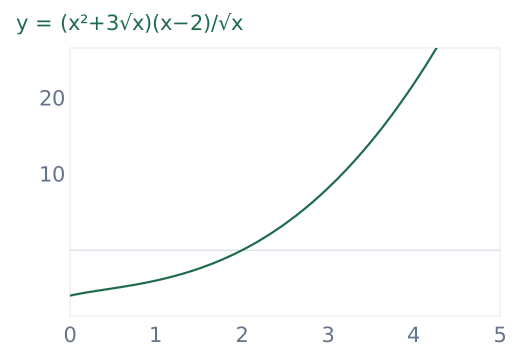
Q50. The curve y = (x² + 3√x)(x − 2) / √x is defined for x > 0. Find its gradient at x = 4.
Free · correct letter only
Answer
Answer: C. 17
The worked solution is part of the full bank. The question and the correct letter are free. Unlock the full bank
Q51. A curve has equation y = (3x² + 4)/(x√x), for x > 0. Find the gradient at x = 4.
Free · correct letter only
Answer
Answer: E. 9/16
The worked solution is part of the full bank. The question and the correct letter are free. Unlock the full bank
Q52. The curve y = x³ − 3px² + 3(p + 2)x + 1 has two distinct turning points, and both of them have positive x-coordinates. Find the complete set of possible values of p.
Free · correct letter only
Answer
Answer: A. p > 2
The worked solution is part of the full bank. The question and the correct letter are free. Unlock the full bank
Q53. Find the complete set of values of k for which the curve y = (x² + k)/(x − 1) has two distinct stationary points.
Free · correct letter only
Answer
Answer: D. k > −1
The worked solution is part of the full bank. The question and the correct letter are free. Unlock the full bank
Q54. The cubic f(x) = x³ + ax² + bx + 7 has exactly one stationary point, and that stationary point is at x = 2. Find a + b.
Free · correct letter only
Answer
Answer: B. 6
The worked solution is part of the full bank. The question and the correct letter are free. Unlock the full bank
Q55. Let f(x) = x1/3(x − 3)². The fraction of the interval 0 < x < 6 on which f is decreasing is
Free · correct letter only
Answer
Answer: A. 3/7
The worked solution is part of the full bank. The question and the correct letter are free. Unlock the full bank
Q56. A curve has equation y = 2x² + 3 and a line has equation y = 5x − 1. What is the shortest distance, measured parallel to the y-axis, between the curve and the line?
Free · correct letter only
Answer
Answer: D. 7/8
The worked solution is part of the full bank. The question and the correct letter are free. Unlock the full bank
Q57. A curve has equation y = x³ − 4x² + a, where a is a constant. The tangent at x = 3 and the normal at x = 1 meet on the x-axis. Find a.
Free · correct letter only
Answer
Answer: B. 15/7
The worked solution is part of the full bank. The question and the correct letter are free. Unlock the full bank
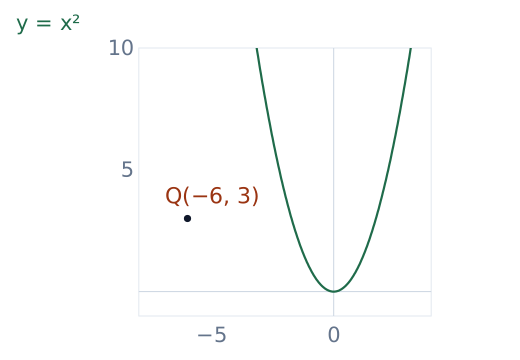
Q58. The point P lies on the curve y = x² and is as close as possible to Q(−6, 3). Find the distance PQ.
Free · correct letter only
Answer
Answer: E. √17
The worked solution is part of the full bank. The question and the correct letter are free. Unlock the full bank
Q59. How many distinct real solutions does the equation x⁴ − 4x³ − 2x² + 12x + 5 = 0 have?
Free · correct letter only
Answer
Answer: C. 4
The worked solution is part of the full bank. The question and the correct letter are free. Unlock the full bank
Q60. What is the term of highest degree in d²/dx²[(x² + 3)²(x² − 1)²] − d/dx[(x² + 1)²(3x³ − 1)]?
Free · correct letter only
Answer
Answer: B. 35x6
The worked solution is part of the full bank. The question and the correct letter are free. Unlock the full bank
Q61. P is a point on the curve y = 3 − x² with positive x-coordinate. The tangent to the curve at P meets the x-axis at M and the y-axis at N, and O is the origin. Find the least possible area of triangle OMN.
Free · correct letter only
Answer
Answer: C. 4
The worked solution is part of the full bank. The question and the correct letter are free. Unlock the full bank
Q62. A curve has equation y = 2x³ + 3px² + (p² + 4)x, where p is real. Let M be the gradient of the normal at x = 1. What is the least possible value of M?
Free · correct letter only
Answer
Answer: A. −1
The worked solution is part of the full bank. The question and the correct letter are free. Unlock the full bank
Q63. How many distinct real solutions does the equation 3x⁵ − 5x³ + 1 = 0 have?
Free · correct letter only
Answer
Answer: C. 3
The worked solution is part of the full bank. The question and the correct letter are free. Unlock the full bank
Q64. The curve y = x³ + bx² + cx + 1, where b and c are real, has a local maximum at x = 1. Which statement must be true?
Free · correct letter only
Answer
Answer: E. b < −3
The worked solution is part of the full bank. The question and the correct letter are free. Unlock the full bank
Q65. Let f(x) = (x − 1)²/(x²)1/3 for every real x ≠ 0. On which complete set of values of x is f decreasing?
Free · correct letter only
Answer
Answer: E. x < −1/2 or 0 < x < 1
The worked solution is part of the full bank. The question and the correct letter are free. Unlock the full bank
Q66. The volume of a balloon is modelled by V = (a − bt)³, where a and b are positive constants and t is the time in seconds, with t ≥ 0. When t = 2 the volume is 27 cm³ and it is decreasing at 18 cm³ per second. Find a.
Free · correct letter only
Answer
Answer: C. 13/3
The worked solution is part of the full bank. The question and the correct letter are free. Unlock the full bank
Q67. The least possible value of the gradient of y = (x + a)²(2x + a), at the point where x = 1, as a varies, is
Free · correct letter only
Answer
Answer: A. −1/4
The worked solution is part of the full bank. The question and the correct letter are free. Unlock the full bank
Q68. A differentiable function f satisfies f'(x) = (x − 4)²(x + 3) for every real x. Which statement is true?
Free · correct letter only
Answer
Answer: B. f has a local minimum at x = −3.
The worked solution is part of the full bank. The question and the correct letter are free. Unlock the full bank
Q69. Let f(x) = 3x⁴ − 8x³ − 6x² + 24x. Find the complete set of values of k for which the equation f(x) = k has four distinct real solutions.
Free · correct letter only
Answer
Answer: B. 8 < k < 13
The worked solution is part of the full bank. The question and the correct letter are free. Unlock the full bank
Paper 2 questions
Paper 2 is Mathematical Reasoning. It can test this same topic. Argument, proof, and identifying errors are the topics that appear on Paper 2 only.
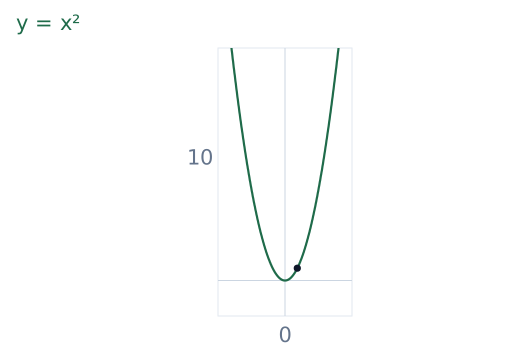
Q1. The tangent to y = x2 at (1, 1) is parallel to the line L, and the distance between the tangent and L is √5. What is the equation of L?
Free · correct letter only
Answer
Answer: C. 2x − y + 4 = 0 or 2x − y − 6 = 0
The worked solution is part of the full bank. The question and the correct letter are free. Unlock the full bank
Q2. A coincidence point of a function f is a real number x such that f(x) = f'(x). Let f(x) = x4 + k, where k is a real constant. Which describes all the values of k for which f has exactly two coincidence points?
Free · correct letter only
Answer
Answer: E. k < 27
The worked solution is part of the full bank. The question and the correct letter are free. Unlock the full bank
Q3. For which values of the constant k do exactly three different tangents to the curve y = x3 − 6x pass through the point (1, k)?
Free · correct letter only
Answer
Answer: A. −6 < k < −5
The worked solution is part of the full bank. The question and the correct letter are free. Unlock the full bank
Q4. The function f is differentiable for all real x, f(1) = 0, and f'(x) > f(x) for every real x. What is the complete set of x for which (x2 − 4) f(x) < 0?
Free · correct letter only
Answer
Answer: D. (−∞, −2) ∪ (1, 2)
The worked solution is part of the full bank. The question and the correct letter are free. Unlock the full bank
Q5. For x > 0, let f(x) = 2(x5 + 3x) / (x5)1/4. Find f'(x).
Free · correct letter only
Answer
Answer: A. (15/2)x11/4 − (3/2)x−5/4
The worked solution is part of the full bank. The question and the correct letter are free. Unlock the full bank
Q6. Given that y = (1 − 2x)2 / (2 x3/2), which one of the following is a correct expression for dy/dx?
Free · correct letter only
Answer
Answer: A. x−1/2 + x−3/2 − (3/4)x−5/2
The worked solution is part of the full bank. The question and the correct letter are free. Unlock the full bank
Q7. The side length of a cube is increasing at 2 cm per second. At the instant when the side length is 3 cm, at what rate is the volume increasing?
Free · correct letter only
Answer
Answer: D. 54 cm³/s
The worked solution is part of the full bank. The question and the correct letter are free. Unlock the full bank
Q8. The function f is given for x > 0 by f(x) = (x3 − 9x) / (3√x). Find f'(9).
Free · correct letter only
Answer
Answer: C. 22
The worked solution is part of the full bank. The question and the correct letter are free. Unlock the full bank
Q9. The function f is a polynomial defined for every real x. Which of the following is necessary and sufficient for f(b) − f(a) ≥ b − a to hold for all real a and b with a < b?
Free · correct letter only
Answer
Answer: C. f'(x) ≥ 1 for every real x
The worked solution is part of the full bank. The question and the correct letter are free. Unlock the full bank
Q10. The polynomial p(x) is increasing for a ≤ x ≤ b, where a < b. Which of the following must be true? I. p'(x) ≥ 0 for a ≤ x ≤ b II. p(x) ≥ p(a) for a ≤ x ≤ b III. (p(x))² is increasing for a ≤ x ≤ b
Free · correct letter only
Answer
Answer: D. I and II only
The worked solution is part of the full bank. The question and the correct letter are free. Unlock the full bank
Q11. How many stationary points does y = 5x4 + 2x3 + 3x2 − 1 have?
Free · correct letter only
Answer
Answer: B. 1
The worked solution is part of the full bank. The question and the correct letter are free. Unlock the full bank
Q12. Let f be a non-constant polynomial. Suppose f(x) = 0 for exactly M distinct real x, and f'(x) = 0 for exactly N distinct real x. Which of these statements are true? I: It is possible that M = N + 2. II: It is possible that M = N + 1. III: It is possible that N = M + 3.
Free · correct letter only
Answer
Answer: E. II and III only
The worked solution is part of the full bank. The question and the correct letter are free. Unlock the full bank
Q13. What is the gradient of y = (2x − 3)2 / (x √x) at x = 9?
Free · correct letter only
Answer
Answer: B. 5/6
The worked solution is part of the full bank. The question and the correct letter are free. Unlock the full bank
Q14. The polynomial y = a x4 + b x3 + c x2 + d x + e has real coefficients and a ≠ 0. Which of the following is not possible?
Free · correct letter only
Answer
Answer: D. The graph has one local minimum and one local maximum.
The worked solution is part of the full bank. The question and the correct letter are free. Unlock the full bank
Q15. The parabola y = x2 + 4ax + 3 has one turning point. For which values of a is that turning point as close as possible to the origin?
Free · correct letter only
Answer
Answer: D. ±√(5/8)
The worked solution is part of the full bank. The question and the correct letter are free. Unlock the full bank
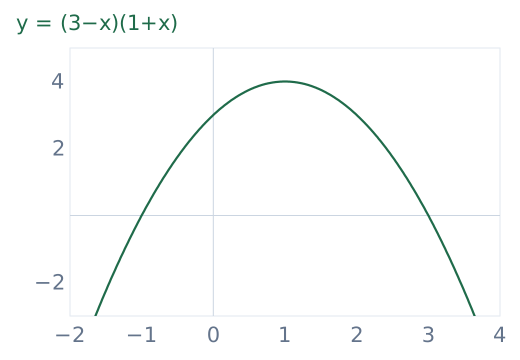
Q16. The curve y = (3 − x)(1 + x) and the curve y = (a − x)(a + x) each have a maximum point. Find the values of the constant a for which these two maximum points are as close as possible.
Free · correct letter only
Answer
Answer: C. ±2
The worked solution is part of the full bank. The question and the correct letter are free. Unlock the full bank
Q17. For x > 0, the function f(x) = x + 36/x has a minimum value. What is this minimum value?
Free · correct letter only
Answer
Answer: B. 12
The worked solution is part of the full bank. The question and the correct letter are free. Unlock the full bank
Q18. For x > 0, let f(x) = x(3 − ln x). What is the greatest value of f(x)?
Free · correct letter only
Answer
Answer: A. e²
The worked solution is part of the full bank. The question and the correct letter are free. Unlock the full bank
Q19. How many real solutions does the equation x³ + 3x − 2 = 0 have?
Free · correct letter only
Answer
Answer: B. 1
The worked solution is part of the full bank. The question and the correct letter are free. Unlock the full bank
Q20. The function f(x) = x⁴ − 8x² + 3 has two local minima. What is the value of f at either local minimum?
Free · correct letter only
Answer
Answer: A. −13
The worked solution is part of the full bank. The question and the correct letter are free. Unlock the full bank
Q21. The curve y = x² + 3 and the line y = 2x do not meet. What is the shortest distance between a point of the curve and a point of the line?
Free · correct letter only
Answer
Answer: B. (2√5)/5
The worked solution is part of the full bank. The question and the correct letter are free. Unlock the full bank
Q22. For 0 ≤ x ≤ 9, let f(x) = x√(9 − x). What is the greatest value of f(x)?
Free · correct letter only
Answer
Answer: D. 6√3
The worked solution is part of the full bank. The question and the correct letter are free. Unlock the full bank
Q23. For x ≥ 0, let f(x) = x³(25 − x²). At the maximum point of f, what is the value of x²?
Free · correct letter only
Answer
Answer: C. 15
The worked solution is part of the full bank. The question and the correct letter are free. Unlock the full bank
Q24. An open box is made by cutting squares of side x cm from each corner of a 12 cm by 12 cm sheet and folding up the sides. What is the greatest possible volume of the box?
Free · correct letter only
Answer
Answer: C. 128 cm³
The worked solution is part of the full bank. The question and the correct letter are free. Unlock the full bank
Q25. The function f is differentiable for every real x. Let P be the statement “f'(2) = 0”, and let Q be the statement “f has a turning point at x = 2”. Which of the following is correct?
Free · correct letter only
Answer
Answer: B. P is necessary but not sufficient for Q
The worked solution is part of the full bank. The question and the correct letter are free. Unlock the full bank
Q26. Find the minimum value of f(x) = x3 − 3x2 − 9x + 10 for 0 ≤ x ≤ 4.
Free · correct letter only
Answer
Answer: A. −17
The worked solution is part of the full bank. The question and the correct letter are free. Unlock the full bank
Q27. Find the values of a for which the turning point of y = x2 + 2 a x + 4 is as close as possible to the origin.
Free · correct letter only
Answer
Answer: E. a = ± √(7/2)
The worked solution is part of the full bank. The question and the correct letter are free. Unlock the full bank
Q28. The curve y = 5 − (x − 2a)2 and the curve y = a − x2 each have a maximum point. Find the value of a for which these two maximum points are as close as possible.
Free · correct letter only
Answer
Answer: C. 1
The worked solution is part of the full bank. The question and the correct letter are free. Unlock the full bank
Q29. The function f is defined for all real x by f(x) = (x + 1)/(x² + 3). What is the difference between the greatest value and the least value of f(x)?
Free · correct letter only
Answer
Answer: A. 2/3
The worked solution is part of the full bank. The question and the correct letter are free. Unlock the full bank
Q30. For how many of these functions is the derivative strictly increasing for every real x? The functions are ex, sin x, x², x³ and cos x.
Free · correct letter only
Answer
Answer: C. 2
The worked solution is part of the full bank. The question and the correct letter are free. Unlock the full bank