
Question 1Algebra and functions
TMUA Algebra and Functions — Practice Questions by Topic
These are SummitPapers original questions, not official past paper questions. Official TMUA questions sorted by topic are on TMUA past papers by topic.
- MM1Algebra and functions
- 182 questions129 on Paper 1 · 53 on Paper 2
- 9 free solutionsThe rest show the correct letter only
Covers: quadratics and the discriminant, linear and quadratic inequalities, polynomials and the factor and remainder theorems, composite and inverse functions, modulus equations and inequalities, binomial expansions, surds and indices, simultaneous equations.
What this topic tests
Algebra and functions, as set out for this test, covers quadratics and the discriminant, inequalities, the factor and remainder theorems, composite and inverse functions, the modulus, binomial expansions, surds and indices, and simultaneous equations.
How it is assessed
This is Section 1, so both papers can test it. This set has questions on Paper 1 and on Paper 2. Each question has five options. A paper is 20 questions in 75 minutes, with no calculator.
This note is written for SummitPapers. The official list of what can be examined is the specification, together with the Notes on Mathematics and, for Paper 2, the Notes on Logic and Proof.
Key methods
The discriminant
For ax² + bx + c = 0, the discriminant b² − 4ac tells you how many real roots there are. An inequality in a parameter often becomes a statement about that discriminant.
Factor and remainder
The remainder when a polynomial is divided by x − a is the value of the polynomial at a. If that value is 0, then x − a is a factor.
A modulus is two cases
An equation with a modulus splits where the inside changes sign. Dropping the modulus and solving one linear equation keeps only one of the cases.
Common mistakes
Dividing away a root
Dividing an equation by x, or by x − a, is only valid when that factor is not zero. The lost root is often one of the options.
The wrong binomial coefficient
The term in x^r inside (a + b)^n uses nCr, not n × r. The powers of a and b must still add to n.
Worked example
This question is also in the list below, with the solution folded. It is opened here so the method is on the page before the other questions.
The expansion of (2x + c)3 is 8x3 − 36x2 + 54x + 3k, where c and k are real constants. Find k.
Answer: C. −9
Worked solution. Expand (2x + c)3 = 8x3 + 12c x2 + 6c2 x + c3. The x2 coefficient gives 12c = −36, so c = −3. Then 6c2 = 6 × 9 = 54, which matches the given x coefficient. The constant term is c3 = −27, and this equals 3k, so k = −9.
Why the other options look right. A sets k = 3c3 = −81. B reports the constant term c3 = −27 and does not divide by 3. D reports c = −3. E takes c = 3 from the unsigned x2 coefficient, then computes c3/3 = 9.
Paper 1 questions
Paper 1 is Applications of Mathematical Knowledge. Calculators are not allowed.
Q1. The expansion of (2x + c)3 is 8x3 − 36x2 + 54x + 3k, where c and k are real constants. Find k.
Free · worked solution included
Answer and worked solution
Answer: C. −9
Worked solution. Expand (2x + c)3 = 8x3 + 12c x2 + 6c2 x + c3. The x2 coefficient gives 12c = −36, so c = −3. Then 6c2 = 6 × 9 = 54, which matches the given x coefficient. The constant term is c3 = −27, and this equals 3k, so k = −9.
Why the other options look right. A sets k = 3c3 = −81. B reports the constant term c3 = −27 and does not divide by 3. D reports c = −3. E takes c = 3 from the unsigned x2 coefficient, then computes c3/3 = 9.
Q2. The cubic x3 − 3x2 − 6x + c, where c is a constant, has (x − 1) as a factor. Which product is a complete factorisation of this cubic?
Free · worked solution included
Answer and worked solution
Answer: A. (x − 1)(x − 4)(x + 2)
Worked solution. The factor theorem gives 1 − 3 − 6 + c = 0, so c = 8. Dividing x3 − 3x2 − 6x + 8 by (x − 1) leaves x2 − 2x − 8. The pair of numbers multiplying to −8 and adding to −2 is −4 and 2, so x2 − 2x − 8 = (x − 4)(x + 2). The complete factorisation is (x − 1)(x − 4)(x + 2).
Why the other options look right. B uses the pair −8 and 1, which add to −7. C factors x2 − 2x − 8 with the pair 4 and −2, which add to +2. D uses the pair 8 and −1, which add to 7, and so repeats (x − 1). E uses the pair −4 and −2, which multiply to +8 rather than −8.
Q3. The roots of x3 − 5x2 + px + q = 0 have product −5, and the sum of the products of the roots taken two at a time is −1. Find p + q.
Free · worked solution included
Answer and worked solution
Answer: C. 4
Worked solution. For x3 − (sum)x2 + (pairwise sum)x − (product) = 0, the pairwise sum is p and the product is −q. Thus p = −1 and −q = −5, so q = 5. Therefore p + q = −1 + 5 = 4. (The cubic is x3 − 5x2 − x + 5 = (x + 1)(x − 1)(x − 5); its roots −1, 1 and 5 have sum 5, product −5 and pairwise sum −1.)
Why the other options look right. A takes the product to be q rather than −q, so q = −5 and p + q = −1 + (−5) = −6. B gives p = −1 only. D gives q = 5 only. E takes p to be the sum of the roots, 5, and computes 5 + 5 = 10.
Q4. The equation x2 − kx + (2k − 4) = 0 has one root equal to twice the other. Find the sum of the possible values of k.
Free · worked solution included
Answer and worked solution
Answer: D. 9
Worked solution. Let the roots be t and 2t. Their sum is 3t = k and their product is 2t2 = 2k − 4. Substituting k = 3t gives 2t2 = 6t − 4, so t2 − 3t + 2 = 0, hence (t − 1)(t − 2) = 0. The solutions are t = 1, giving k = 3 (roots 1 and 2), and t = 2, giving k = 6 (roots 2 and 4). Both give real roots of the stated form. The sum of the possible values is 3 + 6 = 9.
Why the other options look right. A reports only k = 3, from the roots 1 and 2. B reads the condition as the two roots being equal and sets the discriminant k2 − 4(2k − 4) = (k − 4)2 to zero, giving k = 4. C reports only k = 6, from the roots 2 and 4. E multiplies the two possible values instead of adding them, 3 × 6 = 18.
Q5. The numbers α and β are the roots of x2 − 4x − 1 = 0. Find α3 + β3.
Free · worked solution included
Answer and worked solution
Answer: E. 76
Worked solution. From the quadratic, α + β = 4 and αβ = −1. Then α3 + β3 = (α + β)((α + β)2 − 3αβ) = 4(16 − 3(−1)) = 4(16 + 3) = 4 × 19 = 76.
Why the other options look right. A uses the product of the roots as +1, giving 4(16 − 3) = 52. B assumes α3 + β3 = (α + β)3, dropping the cross term −3αβ(α + β), and gets 43 = 64. C replaces 3αβ by αβ, giving 4(16 − (−1)) = 68. D computes (α + β)(α2 + β2) = 4(16 + 2) = 72.
Q6. Let f(x) = 3x − 1 and g(x) = x2 + 2x. Find g(f(x)).
Free · worked solution included
Answer and worked solution
Answer: E. 9x2 − 1
Worked solution. Substitute f(x) into g: g(3x − 1) = (3x − 1)2 + 2(3x − 1) = 9x2 − 6x + 1 + 6x − 2. The linear terms cancel, leaving 9x2 − 1.
Why the other options look right. A is (3x − 1)2, with the term 2f(x) omitted. B expands (3x − 1)2 as 9x2 + 6x + 1 and then adds 2(3x − 1), getting 9x2 + 12x − 1. C subtracts 2f(x) instead of adding it, getting 9x2 − 12x + 3. D is f(g(x)) = 3(x2 + 2x) − 1.
Q7. Find every real x for which (x2 − x − 6)/(x − 3) is at least 2.
Free · worked solution included
Answer and worked solution
Answer: D. x ≥ 0 and x ≠ 3
Worked solution. For x ≠ 3 the numerator factors as (x − 3)(x + 2), so the quotient equals x + 2. The inequality becomes x + 2 ≥ 2, that is x ≥ 0, and x = 3 is excluded because the original denominator is zero. The solution is x ≥ 0 and x ≠ 3.
Why the other options look right. A cancels the factor x − 3 and then leaves x = 3 in the solution. B keeps only the part of x ≥ 0 on which the denominator is positive, namely x > 3. C multiplies both sides by x − 3 with no sign check, obtaining x(x − 3) ≥ 0, and then excludes x = 3, which gives x ≤ 0 or x > 3. E reverses the simplified inequality to x + 2 ≤ 2, which gives x ≤ 0.
Q8. The polynomial p(x) = x3 − 9x2 + ax + b has roots r, s and t. Given that r + s = 5 and rs + rt + st = 26, find a and b.
Free · worked solution included
Answer and worked solution
Answer: D. a = 26, b = −24
Worked solution. For x3 − 9x2 + ax + b, Vieta's formulas give r + s + t = 9 and rs + rt + st = a. Thus a = 26 and t = 9 − 5 = 4. Then rs + t(r + s) = 26 becomes rs + 20 = 26, so rs = 6. The product of the roots is 6 × 4 = 24, and b = −(rst) = −24. So a = 26, b = −24.
Why the other options look right. A uses r + s = 5 as the coefficient a. B uses the sum of all three roots, 9, as the coefficient a. C takes b to be the product rst rather than −rst. E sets b = −rs and forgets to multiply by t.
Q9. What is the largest real root of x3 − 5x2 − 8x + 12 = 0?
Free · correct letter only
Answer
Answer: D. 6
The worked solution is part of the full bank. The question and the correct letter are free. Unlock the full bank
Q10. For a real number of hours x, the cost in pounds of running a kiln is C(x) = 2x2 − 12x + 25. Find the minimum cost.
Free · correct letter only
Answer
Answer: D. 7
The worked solution is part of the full bank. The question and the correct letter are free. Unlock the full bank
Q11. Solve the inequality |x2 − 4x + 1| < 2.
Free · correct letter only
Answer
Answer: E. 2 − √5 < x < 1 or 3 < x < 2 + √5
The worked solution is part of the full bank. The question and the correct letter are free. Unlock the full bank
Q12. Find the number of real solutions of the equation |x + 3| = 7 − x − 2x2.
Free · correct letter only
Answer
Answer: D. 2
The worked solution is part of the full bank. The question and the correct letter are free. Unlock the full bank
Q13. The graph of y = 2x2 + x − 6 lies on or below the x-axis for which values of x?
Free · correct letter only
Answer
Answer: D. −2 ≤ x ≤ 3/2
The worked solution is part of the full bank. The question and the correct letter are free. Unlock the full bank
Q14. The roots of x3 − 5x2 + 2x + 8 = 0 are all nonzero. Find the sum of the reciprocals of the roots.
Free · correct letter only
Answer
Answer: C. −1/4
The worked solution is part of the full bank. The question and the correct letter are free. Unlock the full bank
Q15. Which list gives every real solution of |3x − 4| = |x + 6|?
Free · correct letter only
Answer
Answer: B. −1/2 and 5
The worked solution is part of the full bank. The question and the correct letter are free. Unlock the full bank
Q16. The number z is nonzero and z + 1/z = 3. What is z3 + 1/z3?
Free · correct letter only
Answer
Answer: B. 18
The worked solution is part of the full bank. The question and the correct letter are free. Unlock the full bank
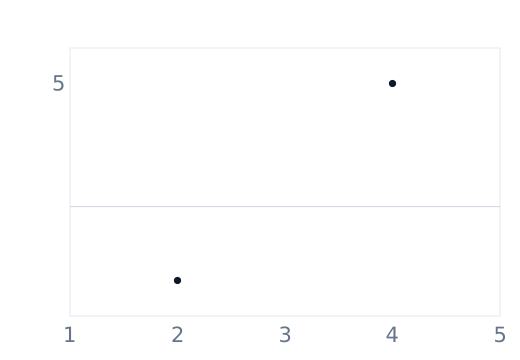
Q17. The graph of y = p(x − 2)2 + q has its vertex at (2, −3) and passes through (4, 5). What is p + q?
Free · correct letter only
Answer
Answer: B. −1
The worked solution is part of the full bank. The question and the correct letter are free. Unlock the full bank
Q18. Find the complete set of real x for which (x2 − 4)/(x − 3) < 0.
Free · correct letter only
Answer
Answer: A. x < −2 or 2 < x < 3
The worked solution is part of the full bank. The question and the correct letter are free. Unlock the full bank
Q19. The polynomial f(x) = x3 − 4x2 + x + k passes through the point (3, 4). What is k?
Free · correct letter only
Answer
Answer: E. 10
The worked solution is part of the full bank. The question and the correct letter are free. Unlock the full bank
Q20. Write floor(t) for the greatest integer less than or equal to t. What is the sum of all real solutions of x2 = floor(x) + 2?
Free · correct letter only
Answer
Answer: A. 1 + √3
The worked solution is part of the full bank. The question and the correct letter are free. Unlock the full bank
Q21. The expansion of (ax + b)3 is 8x3 − q x2 + 24x − 8, where a, b and q are real and a > 0. Find q.
Free · correct letter only
Answer
Answer: D. 24
The worked solution is part of the full bank. The question and the correct letter are free. Unlock the full bank
Q22. The number a is chosen so that x + 3 is a factor of 2x3 + 3x2 − 11x + a. Which product is a complete factorisation of this cubic?
Free · correct letter only
Answer
Answer: A. (x + 3)(x − 2)(2x + 1)
The worked solution is part of the full bank. The question and the correct letter are free. Unlock the full bank
Q23. The coefficient of x3 in the expansion of (1 + 2x + 3x2)5 is twice the coefficient of x4 in the expansion of (1 − a x2)5. Find every possible value of the constant a.
Free · correct letter only
Answer
Answer: C. ±√10
The worked solution is part of the full bank. The question and the correct letter are free. Unlock the full bank
Q24. S is the set of real x that satisfy both x2 − 7x + 10 < 0 and 3x − 1 > 8. Which single inequality describes S?
Free · correct letter only
Answer
Answer: C. x2 − 8x + 15 < 0
The worked solution is part of the full bank. The question and the correct letter are free. Unlock the full bank
Q25. The solution set of x² + bx + c < 0 is p < x < q, where b, c, p and q are real constants with c < 0 and p < q. What is the solution set of cx² + bx + 1 < 0?
Free · correct letter only
Answer
Answer: C. x < 1/p or x > 1/q
The worked solution is part of the full bank. The question and the correct letter are free. Unlock the full bank
Q26. The curves y = x² − 4x + a and y = 2x − x² meet at two distinct points, and both points have positive x-coordinates. Here a is a real constant. What is the complete set of possible values of a?
Free · correct letter only
Answer
Answer: E. 0 < a < 9/2
The worked solution is part of the full bank. The question and the correct letter are free. Unlock the full bank
Q27. The polynomial f(x) = x3 + ax2 + bx + c uses each of 2, 3 and 4 once as a, b and c. Let R be the remainder on division by x + 1, and let S be the remainder on division by x + 2. What is the largest possible value of R − S?
Free · correct letter only
Answer
Answer: C. 5
The worked solution is part of the full bank. The question and the correct letter are free. Unlock the full bank
Q28. The real numbers x and y satisfy |x − 1| ≤ 3 and |y + 1| ≤ 5. What is the greatest possible value of |xy|?
Free · correct letter only
Answer
Answer: D. 24
The worked solution is part of the full bank. The question and the correct letter are free. Unlock the full bank
Q29. The quadratic f has a turning point at (2, −3) and the graph of y = f(x) passes through (5, 15). Which expression is f(x)?
Free · correct letter only
Answer
Answer: B. 2x² − 8x + 5
The worked solution is part of the full bank. The question and the correct letter are free. Unlock the full bank
Q30. Find the complete set of real k for which x² + kx + (k + 3) is positive for every real x.
Free · correct letter only
Answer
Answer: C. −2 < k < 6
The worked solution is part of the full bank. The question and the correct letter are free. Unlock the full bank
Q31. (2x − 1) and (x + 3) are factors of 2x3 + px2 + q, which has no x term. What is the value of 3p + q?
Free · correct letter only
Answer
Answer: E. 84/5
The worked solution is part of the full bank. The question and the correct letter are free. Unlock the full bank
Q32. Find the complete set of values of x for which (x + 6)(x + 1)(3 − x) > 0 and (x + 4)(x − 2) < 0.
Free · correct letter only
Answer
Answer: A. −1 < x < 2
The worked solution is part of the full bank. The question and the correct letter are free. Unlock the full bank
Q33. The curve y = px2 + 8x − q, where p and q are constants, has a line of symmetry x = −1/3 and touches the x-axis at exactly one point. What is the value of p + 3q?
Free · correct letter only
Answer
Answer: D. 8
The worked solution is part of the full bank. The question and the correct letter are free. Unlock the full bank
Q34. The function f is defined for all real x by f(x) = (p − x)(x + 3), where p is a real constant. Find the complete set of values of p for which the maximum value of f(x) is less than p + 6.
Free · correct letter only
Answer
Answer: A. −5 < p < 3
The worked solution is part of the full bank. The question and the correct letter are free. Unlock the full bank
Q35. The quadratic x2 − 8x + 4 factorises as (x − α)(x − β), where α and β are positive real numbers. Which quadratic factorises as (x − √α)(x − √β)?
Free · correct letter only
Answer
Answer: C. x2 − √12 x + 2
The worked solution is part of the full bank. The question and the correct letter are free. Unlock the full bank
Q36. What is the coefficient of x5 in the expansion of (1 + x)9 (1 − x)8?
Free · correct letter only
Answer
Answer: A. 28
The worked solution is part of the full bank. The question and the correct letter are free. Unlock the full bank
Q37. What is the lowest positive integer n for which n2 − 30n − 30 is positive?
Free · correct letter only
Answer
Answer: C. 31
The worked solution is part of the full bank. The question and the correct letter are free. Unlock the full bank
Q38. For how many real values of a does the equation (x − a)(x2 − 4x + a) = 0 have exactly two distinct real solutions?
Free · correct letter only
Answer
Answer: D. 3
The worked solution is part of the full bank. The question and the correct letter are free. Unlock the full bank
Q39. The function f satisfies f(mn) = f(m)f(n) whenever mn is a multiple of 5, and f(mn) = mn otherwise, for all positive integers m and n. Given that f(25) + f(4) − f(20) = 0, what is f(5)?
Free · correct letter only
Answer
Answer: D. 2
The worked solution is part of the full bank. The question and the correct letter are free. Unlock the full bank
Q40. In the expansion of (a + bx)n, where a and b are positive and n is a positive integer, the third term in ascending powers of x is 90x2, the fourth term in ascending powers of x is 240x3, and the fourth term in descending powers of x is also 240x3. What is (a/b)2?
Free · correct letter only
Answer
Answer: E. 1/4
The worked solution is part of the full bank. The question and the correct letter are free. Unlock the full bank
Q41. Let a > 0 and suppose that a + 4/a = 5. What is the value of a² + 16/a²?
Free · correct letter only
Answer
Answer: B. 17
The worked solution is part of the full bank. The question and the correct letter are free. Unlock the full bank
Q42. The real numbers a and b are nonzero and satisfy (a3 + 4/b3)(4/a3 − b3) = 6. What is the least possible value of ab?
Free · correct letter only
Answer
Answer: B. −2
The worked solution is part of the full bank. The question and the correct letter are free. Unlock the full bank
Q43. The line y = x − 2 meets the curve x2 + xy − y2 = 7 at two points. What is the sum of the x-coordinates of those points?
Free · correct letter only
Answer
Answer: C. −2
The worked solution is part of the full bank. The question and the correct letter are free. Unlock the full bank
Q44. What is the complete set of real x for which (x2 − 4)(x − 1) < 0?
Free · correct letter only
Answer
Answer: E. x < −2 or 1 < x < 2
The worked solution is part of the full bank. The question and the correct letter are free. Unlock the full bank
Q45. The linear factor x − 1 divides x3 + m x2 − x(m − 2)2 + 4. What is the sum of the possible values of m?
Free · correct letter only
Answer
Answer: D. 5
The worked solution is part of the full bank. The question and the correct letter are free. Unlock the full bank
Q46. The roots of 3x2 − 10x + k = 0 differ by 1. What is k?
Free · correct letter only
Answer
Answer: C. 91/12
The worked solution is part of the full bank. The question and the correct letter are free. Unlock the full bank
Q47. How many real roots does (x2 + 3x)2 = 6 have?
Free · correct letter only
Answer
Answer: C. 2
The worked solution is part of the full bank. The question and the correct letter are free. Unlock the full bank
Q48. For which non-zero real numbers k does the quadratic equation k x2 + 4x + k − 3 = 0 have two distinct real roots?
Free · correct letter only
Answer
Answer: B. −1 < k < 4 and k ≠ 0
The worked solution is part of the full bank. The question and the correct letter are free. Unlock the full bank
Q49. S is the set of real x that satisfy both x² − 6x + 5 < 0 and x² − 2x − 3 < 0. Which single inequality describes S?
Free · correct letter only
Answer
Answer: C. x² − 4x + 3 < 0
The worked solution is part of the full bank. The question and the correct letter are free. Unlock the full bank
Q50. For integers a and b, which condition is enough to guarantee that 2a × 3b / (6a − b × 9b) is an integer?
Free · correct letter only
Answer
Answer: C. a ≤ 0 and b ≥ 0
The worked solution is part of the full bank. The question and the correct letter are free. Unlock the full bank
Q51. The polynomial (2x² − x + 3)(ax + 1) is divided by x − 1 and the remainder is 24. Find a.
Free · correct letter only
Answer
Answer: B. 5
The worked solution is part of the full bank. The question and the correct letter are free. Unlock the full bank
Q52. The inequality |x − 3| + |x + 1| ≤ 8 holds. What is the greatest possible value of |x|?
Free · correct letter only
Answer
Answer: C. 5
The worked solution is part of the full bank. The question and the correct letter are free. Unlock the full bank
Q53. Solve 5x − 7 = 2x + 8.
Free · worked solution included
Answer and worked solution
Answer: C. 5
Worked solution. Subtract 2x from both sides: 3x − 7 = 8. Add 7: 3x = 15. Divide by 3: x = 5. Check: 5(5) − 7 = 18 and 2(5) + 8 = 18.
Why the other options look right. A moves −7 to the right without changing its sign, giving 3x = 8 − 7 = 1 and hence x = 1/3. B collects the x terms as 5x − 2x = 3x and then reports the coefficient 3 as the answer, without solving 3x = 15. D is 15, the value of 3x before dividing by 3. E collects the x terms as 2x − 5x = −3x and still adds 8 and 7, so −3x = 15 and x = −5.
Q54. A function f is defined for every real x except x = 3, and it satisfies 3f(x) − 4f((3x + 4)/(x − 3)) = (52 − 7x)/4. Find f(4).
Free · correct letter only
Answer
Answer: E. 6
The worked solution is part of the full bank. The question and the correct letter are free. Unlock the full bank
Q55. a and b are non-zero integers. Dividing x² − ax − a² by x − b leaves remainder −5. Also, 2x − a is a factor of 2bx² − 3x − 9. Find a + b.
Free · correct letter only
Answer
Answer: C. −2
The worked solution is part of the full bank. The question and the correct letter are free. Unlock the full bank
Q56. Let n be an odd positive integer. What is the remainder when (x + 1)n + (x − 1)n is divided by x2 − 1?
Free · correct letter only
Answer
Answer: C. 2n x
The worked solution is part of the full bank. The question and the correct letter are free. Unlock the full bank
Q57. The graph of a quadratic f crosses the x-axis at x = −1 and x = 5 and passes through (1, 16). Which expression equals f(x)?
Free · correct letter only
Answer
Answer: D. −2x2 + 8x + 10
The worked solution is part of the full bank. The question and the correct letter are free. Unlock the full bank
Q58. Which set is exactly the set of real x that satisfy both x² − 2x − 24 < 0 and x² − 9 > 0?
Free · correct letter only
Answer
Answer: A. −4 < x < −3 or 3 < x < 6
The worked solution is part of the full bank. The question and the correct letter are free. Unlock the full bank
Q59. The cubic x³ − 2x² + 5x + k has remainder 4 on division by x − 1. What is the remainder on division by x − 2?
Free · correct letter only
Answer
Answer: B. 10
The worked solution is part of the full bank. The question and the correct letter are free. Unlock the full bank
Q60. Solve the inequality |4x + 2| ≤ 10.
Free · correct letter only
Answer
Answer: A. −3 ≤ x ≤ 2
The worked solution is part of the full bank. The question and the correct letter are free. Unlock the full bank
Q61. The real numbers x and y satisfy x² + y² = 34 and x + y = 8, with x > y. Find x − y.
Free · correct letter only
Answer
Answer: B. 2
The worked solution is part of the full bank. The question and the correct letter are free. Unlock the full bank
Q62. The function f is defined by f(x) = (4x − 1)/(x + 2) for x ≠ −2. Find f⁻¹(3).
Free · correct letter only
Answer
Answer: C. 7
The worked solution is part of the full bank. The question and the correct letter are free. Unlock the full bank
Q63. How many distinct real roots does x⁴ − 2x² − 8 = 0 have?
Free · correct letter only
Answer
Answer: C. 2
The worked solution is part of the full bank. The question and the correct letter are free. Unlock the full bank
Q64. Evaluate 8 to the power 2/3, plus 25 to the power −1/2.
Free · correct letter only
Answer
Answer: A. 21/5
The worked solution is part of the full bank. The question and the correct letter are free. Unlock the full bank
Q65. Which inequality describes every real x that satisfies both (x − 1)(x − 10) < 0 and (x − 4)(x − 13) < 0?
Free · correct letter only
Answer
Answer: B. 4 < x < 10
The worked solution is part of the full bank. The question and the correct letter are free. Unlock the full bank
Q66. The polynomial x³ − 3x + 4 leaves remainder 2 when it is divided by x − 1. What is the remainder when it is divided by x + 1?
Free · correct letter only
Answer
Answer: E. 6
The worked solution is part of the full bank. The question and the correct letter are free. Unlock the full bank
Q67. Which inequality describes the solution of |2x + 3| ≤ 11?
Free · correct letter only
Answer
Answer: C. −7 ≤ x ≤ 4
The worked solution is part of the full bank. The question and the correct letter are free. Unlock the full bank
Q68. The real numbers x and y satisfy x² + y² = 65 and x + y = 11, with x > y. Find x − y.
Free · correct letter only
Answer
Answer: B. 3
The worked solution is part of the full bank. The question and the correct letter are free. Unlock the full bank
Q69. The function f is defined by f(x) = (4x − 6)/(x − 2) for x not equal to 2. Find the value of the inverse of f at 3.
Free · correct letter only
Answer
Answer: D. 0
The worked solution is part of the full bank. The question and the correct letter are free. Unlock the full bank
Q70. When 1/(√10 − 2) is written with a rational denominator, which expression is obtained?
Free · correct letter only
Answer
Answer: E. (√10 + 2)/6
The worked solution is part of the full bank. The question and the correct letter are free. Unlock the full bank
Q71. How many distinct real roots does the equation x⁴ − 7x² + 12 = 0 have?
Free · correct letter only
Answer
Answer: A. 4
The worked solution is part of the full bank. The question and the correct letter are free. Unlock the full bank
Q72. Which set is exactly the set of real x that satisfy (x − 1)/(x − 4) ≥ 2?
Free · correct letter only
Answer
Answer: E. 4 < x ≤ 7
The worked solution is part of the full bank. The question and the correct letter are free. Unlock the full bank
Q73. Dividing x³ − 3x² + 4x + 1 by x − 1 leaves remainder 3. Find the remainder on division by x + 1.
Free · correct letter only
Answer
Answer: B. −7
The worked solution is part of the full bank. The question and the correct letter are free. Unlock the full bank
Q74. Which inequality is equivalent to |2x − 8| ≤ 6?
Free · correct letter only
Answer
Answer: B. 1 ≤ x ≤ 7
The worked solution is part of the full bank. The question and the correct letter are free. Unlock the full bank
Q75. Suppose x and y are real numbers with x² + y² = 52, x + y = 10 and x > y. Find x − y.
Free · correct letter only
Answer
Answer: E. 2
The worked solution is part of the full bank. The question and the correct letter are free. Unlock the full bank
Q76. The function f is given by f(x) = (4x + 1)/(x − 2), where x is not 2. Find the value of the inverse of f at 5.
Free · correct letter only
Answer
Answer: A. 11
The worked solution is part of the full bank. The question and the correct letter are free. Unlock the full bank
Q77. Write 1/(√13 − 3) with a rational denominator.
Free · correct letter only
Answer
Answer: D. (√13 + 3)/4
The worked solution is part of the full bank. The question and the correct letter are free. Unlock the full bank
Q78. How many distinct real solutions does x⁴ − 11x² + 18 = 0 have?
Free · correct letter only
Answer
Answer: E. 4
The worked solution is part of the full bank. The question and the correct letter are free. Unlock the full bank
Q79. Evaluate 32 to the power 3/5, minus 27 to the power −2/3.
Free · correct letter only
Answer
Answer: D. 71/9
The worked solution is part of the full bank. The question and the correct letter are free. Unlock the full bank
Q80. Which statement describes every real x that satisfies both (x + 4)(x − 5) < 0 and (x + 1)(x − 3) > 0?
Free · correct letter only
Answer
Answer: E. −4 < x < −1 or 3 < x < 5
The worked solution is part of the full bank. The question and the correct letter are free. Unlock the full bank
Q81. Find the remainder when 2x³ − 5x² + 3x + 7 is divided by x + 2.
Free · correct letter only
Answer
Answer: B. −35
The worked solution is part of the full bank. The question and the correct letter are free. Unlock the full bank
Q82. Which inequality is equivalent to |3x + 6| < 15?
Free · correct letter only
Answer
Answer: A. −7 < x < 3
The worked solution is part of the full bank. The question and the correct letter are free. Unlock the full bank
Q83. The real numbers x and y satisfy x + y = 9 and x² + y² = 53, with x > y. Find x − y.
Free · correct letter only
Answer
Answer: D. 5
The worked solution is part of the full bank. The question and the correct letter are free. Unlock the full bank
Q84. Which of these numbers is greatest?
Free · correct letter only
Answer
Answer: C. √77
The worked solution is part of the full bank. The question and the correct letter are free. Unlock the full bank
Q85. The function f is given by f(x) = (2x + 5)/(x − 3), where x is not 3. Find the value of the inverse of f at 4.
Free · correct letter only
Answer
Answer: A. 17/2
The worked solution is part of the full bank. The question and the correct letter are free. Unlock the full bank
Q86. The number (√5 + √2)/(√5 − √2) can be written as p + q√10, where p and q are rational. What is p + q?
Free · correct letter only
Answer
Answer: E. 3
The worked solution is part of the full bank. The question and the correct letter are free. Unlock the full bank
Q87. How many distinct real solutions does x⁴ − 8x² − 9 = 0 have?
Free · correct letter only
Answer
Answer: B. 2
The worked solution is part of the full bank. The question and the correct letter are free. Unlock the full bank
Q88. Both (x − 1)(x − 9) < 0 and (x − 2)(x − 5) < 0. Which of these describes every such real x?
Free · correct letter only
Answer
Answer: C. 2 < x < 5
The worked solution is part of the full bank. The question and the correct letter are free. Unlock the full bank
Q89. Dividing x³ + 3x² − 2x + 4 by x − 1 leaves remainder 6. What remainder is left when the same cubic is divided by x + 2?
Free · correct letter only
Answer
Answer: E. 12
The worked solution is part of the full bank. The question and the correct letter are free. Unlock the full bank
Q90. Solve the inequality |x − 2| > |2x + 1|.
Free · correct letter only
Answer
Answer: D. −3 < x < 1/3
The worked solution is part of the full bank. The question and the correct letter are free. Unlock the full bank
Q91. Suppose x and y are real, with x² + y² = 85, x + y = 11 and x > y. Find x − y.
Free · correct letter only
Answer
Answer: C. 7
The worked solution is part of the full bank. The question and the correct letter are free. Unlock the full bank
Q92. Let f(x) = (3x − 2)/(x + 4), where x ≠ −4. Find f⁻¹(5).
Free · correct letter only
Answer
Answer: A. −11
The worked solution is part of the full bank. The question and the correct letter are free. Unlock the full bank
Q93. How many distinct real solutions does x⁴ − 29x² + 100 = 0 have?
Free · correct letter only
Answer
Answer: C. 4
The worked solution is part of the full bank. The question and the correct letter are free. Unlock the full bank
Q94. Both (x − 1)(x − 8) < 0 and (x − 4)(x − 10) < 0 hold. Which inequality describes exactly those real x?
Free · correct letter only
Answer
Answer: B. 4 < x < 8
The worked solution is part of the full bank. The question and the correct letter are free. Unlock the full bank
Q95. Dividing x3 − x2 + 3x − 5 by x − 1 leaves remainder −2. Find the remainder on division by x + 1.
Free · correct letter only
Answer
Answer: E. −10
The worked solution is part of the full bank. The question and the correct letter are free. Unlock the full bank
Q96. Solve the inequality |x² − 4| < 3x.
Free · correct letter only
Answer
Answer: A. 1 < x < 4
The worked solution is part of the full bank. The question and the correct letter are free. Unlock the full bank
Q97. The function f is defined by f(x) = (kx + 5)/(2x − 3) for x ≠ 3/2, where k is a constant. For which k does f(f(x)) = x hold for every x in the domain of f with f(x) ≠ 3/2?
Free · correct letter only
Answer
Answer: A. k = 3
The worked solution is part of the full bank. The question and the correct letter are free. Unlock the full bank
Q98. How many distinct real solutions does x6 − 7x3 − 8 = 0 have?
Free · correct letter only
Answer
Answer: D. 2
The worked solution is part of the full bank. The question and the correct letter are free. Unlock the full bank
Q99. Which statement describes every real x that satisfies x² − 5|x| + 4 < 0?
Free · correct letter only
Answer
Answer: E. −4 < x < −1 or 1 < x < 4
The worked solution is part of the full bank. The question and the correct letter are free. Unlock the full bank
Q100. What remainder does the polynomial 2x³ − x² + 5x − 3 leave when it is divided by x − 2?
Free · correct letter only
Answer
Answer: B. 19
The worked solution is part of the full bank. The question and the correct letter are free. Unlock the full bank
Q101. Find the set of real x satisfying |3x − 4| ≤ 8.
Free · correct letter only
Answer
Answer: E. −4/3 ≤ x ≤ 4
The worked solution is part of the full bank. The question and the correct letter are free. Unlock the full bank
Q102. The real numbers x and y satisfy x² + y² = 58 and x + y = 10, with x > y. What is x − y?
Free · correct letter only
Answer
Answer: B. 4
The worked solution is part of the full bank. The question and the correct letter are free. Unlock the full bank
Q103. The function f is defined by f(x) = (3x + 2)/(x − 4) for x ≠ 4. What is the value of the inverse of f at 2?
Free · correct letter only
Answer
Answer: E. −10
The worked solution is part of the full bank. The question and the correct letter are free. Unlock the full bank
Q104. How many distinct real roots does x⁴ − 26x² + 25 = 0 have?
Free · correct letter only
Answer
Answer: B. 4
The worked solution is part of the full bank. The question and the correct letter are free. Unlock the full bank
Q105. What is the maximum value of −2x2 + 12x − y2 + 8y − 30?
Free · correct letter only
Answer
Answer: C. 4
The worked solution is part of the full bank. The question and the correct letter are free. Unlock the full bank
Q106. Find the sum of the real solutions of the equation x2 + 2√(x2 + 8x) = 15 − 8x.
Free · correct letter only
Answer
Answer: A. −8
The worked solution is part of the full bank. The question and the correct letter are free. Unlock the full bank
Q107. The expansion of (√2 − x)6 is 8 − b x + 60 x2 − d x3 + 30 x4 − f x5 + x6, where b, d and f are positive. What is b + d + f?
Free · correct letter only
Answer
Answer: D. 70√2
The worked solution is part of the full bank. The question and the correct letter are free. Unlock the full bank
Q108. The function f is defined for every real x except x = 2, and 2 f(x) − 3 f((2x + 6)/(x − 2)) = 5x + 1. What is f(5)?
Free · correct letter only
Answer
Answer: B. −27
The worked solution is part of the full bank. The question and the correct letter are free. Unlock the full bank
Q109. The coefficient of x4 in the expansion of (3 + x2)5 is equal to 5 times the coefficient of x2 in the expansion of (1 + ax)4. What are the possible values of a?
Free · correct letter only
Answer
Answer: B. ±3
The worked solution is part of the full bank. The question and the correct letter are free. Unlock the full bank
Q110. The coefficient of x3 in the expansion of (3 + bx)5 is 6 times the coefficient of x2 in the expansion of (1 + bx)4. Given that b is not 0, what is b?
Free · correct letter only
Answer
Answer: C. 2/5
The worked solution is part of the full bank. The question and the correct letter are free. Unlock the full bank
Q111. The numbers r and s are non-zero integers. Which condition guarantees that (24r × 3s) / 36r is an integer?
Free · correct letter only
Answer
Answer: C. 0 < r ≤ s
The worked solution is part of the full bank. The question and the correct letter are free. Unlock the full bank
Q112. Suppose u = 56 and v = 65. Which expression is equal to 3030?
Free · correct letter only
Answer
Answer: E. u5 v6
The worked solution is part of the full bank. The question and the correct letter are free. Unlock the full bank
Q113. Find the set of values of x that satisfy both (5x + 2)/(x − 2) < 4 and (x + 3)(x − 5) > 0.
Free · correct letter only
Answer
Answer: E. −10 < x < −3
The worked solution is part of the full bank. The question and the correct letter are free. Unlock the full bank
Q114. Find the set of values of x that satisfy 4/(x + 2) > (x − 3)/x.
Free · correct letter only
Answer
Answer: E. −2 < x < −1 or 0 < x < 6
The worked solution is part of the full bank. The question and the correct letter are free. Unlock the full bank
Q115. The number p is a positive constant. Find the set of values of x that satisfy (x + p)/(x + 9p) < p/x.
Free · correct letter only
Answer
Answer: D. −9p < x < −3p or 0 < x < 3p
The worked solution is part of the full bank. The question and the correct letter are free. Unlock the full bank
Q116. The curve y = x3 + kx2 − 32 has exactly two distinct real x-intercepts for one value of the constant k. Find that value of k.
Free · correct letter only
Answer
Answer: C. 6
The worked solution is part of the full bank. The question and the correct letter are free. Unlock the full bank
Q117. The equation 3x2 + 8x − k = 0, where k is a constant, has two distinct real roots, and one root is 3 more than the other. Find k.
Free · correct letter only
Answer
Answer: D. 17/12
The worked solution is part of the full bank. The question and the correct letter are free. Unlock the full bank
Q118. Find the minimum value of 2(3sin x) − 9sin x + 16/3.
Free · correct letter only
Answer
Answer: A. 7/3
The worked solution is part of the full bank. The question and the correct letter are free. Unlock the full bank
Q119. When (x2 − 3x + 1) is multiplied by (px + 1), and the product is divided by (x − 2), the remainder is 10. Find p.
Free · correct letter only
Answer
Answer: C. −11/2
The worked solution is part of the full bank. The question and the correct letter are free. Unlock the full bank
Q120. The equations x2 − xy = 4 and y − 2x = p, where p is a real constant, have two distinct real solutions. Which statement describes every value p can take?
Free · correct letter only
Answer
Answer: C. p < −4 or p > 4
The worked solution is part of the full bank. The question and the correct letter are free. Unlock the full bank
Q121. What is the sum of the real solutions of |x| − 6 = |2x + 18|?
Free · correct letter only
Answer
Answer: D. −20
The worked solution is part of the full bank. The question and the correct letter are free. Unlock the full bank
Q122. How many distinct real solutions does the equation |x2 − 1| = 2|x| have?
Free · correct letter only
Answer
Answer: E. 4
The worked solution is part of the full bank. The question and the correct letter are free. Unlock the full bank
Q123. The non-zero real numbers a and b satisfy (a3 + 9/b3)(b3 − 9/a3) = 24. What is the least possible value of ab?
Free · correct letter only
Answer
Answer: C. −31/3
The worked solution is part of the full bank. The question and the correct letter are free. Unlock the full bank
Q124. The function f satisfies 3f(x) + f(−x) = 4x + 12 for every real x. Find f(1).
Free · correct letter only
Answer
Answer: B. 5
The worked solution is part of the full bank. The question and the correct letter are free. Unlock the full bank
Q125. The function f satisfies 2f(x) − f((2x + 5)/(x − 2)) = 3x − 3 for every real x except x = 2. What is f(3)?
Free · correct letter only
Answer
Answer: B. 14
The worked solution is part of the full bank. The question and the correct letter are free. Unlock the full bank
Q126. The function f is given by f(x) = (x − k)/(x2 − 6x − k), for the real x at which it is defined, where k is a constant. The range of f is all of the real numbers. What are the possible values of k?
Free · correct letter only
Answer
Answer: D. 0 < k < 7
The worked solution is part of the full bank. The question and the correct letter are free. Unlock the full bank
Q127. The curve y = (x − 1)(x − 2)(x − 4)(x + 2)(x + 5)(x − 6) and the line y = 5x − 8 meet at exactly six points. What is the sum of the x-coordinates of these six points?
Free · correct letter only
Answer
Answer: C. 6
The worked solution is part of the full bank. The question and the correct letter are free. Unlock the full bank
Q128. A cubic polynomial f satisfies f(1) = 1, f(4) = 16 and f(−2) = 4, and the coefficient of x³ is 3. What is f(3)?
Free · correct letter only
Answer
Answer: E. −21
The worked solution is part of the full bank. The question and the correct letter are free. Unlock the full bank
Q129. The polynomial f has degree 1. The composition f(x² − 6x + 13) has exactly two roots, at x = 1 and x = 5, and its minimum value is −12. Which statement about f(x² + 4x + 8) is true?
Free · correct letter only
Answer
Answer: B. The roots are x = −4 and x = 0, and the minimum value is −12.
The worked solution is part of the full bank. The question and the correct letter are free. Unlock the full bank
Paper 2 questions
Paper 2 is Mathematical Reasoning. It can test this same topic. Argument, proof, and identifying errors are the topics that appear on Paper 2 only.
Q1. The quadratic y = f(x) has a turning point at (−1, 5) and passes through (2, 14). What is f(x)?
Free · correct letter only
Answer
Answer: C. x2 + 2x + 6
The worked solution is part of the full bank. The question and the correct letter are free. Unlock the full bank
Q2. The function f is odd and defined for all real x, and f(x) = x2 − 4x for every x > 0. How many real solutions does the equation f(x) = 3 have?
Free · correct letter only
Answer
Answer: C. 3
The worked solution is part of the full bank. The question and the correct letter are free. Unlock the full bank
Q3. The real numbers x and y satisfy 0 < x < y. Which one of the following must be true?
Free · correct letter only
Answer
Answer: E. x/(x + 1) < y/(y + 1)
The worked solution is part of the full bank. The question and the correct letter are free. Unlock the full bank
Q4. Let f(x) = x² − 2ax + 3, where a is a real constant. For which values of a is f(x) > 0 for every x with 0 ≤ x ≤ 2?
Free · correct letter only
Answer
Answer: C. a < √3
The worked solution is part of the full bank. The question and the correct letter are free. Unlock the full bank
Q5. Find the constant term in the expansion of (x5 − x−3)8.
Free · correct letter only
Answer
Answer: B. −56
The worked solution is part of the full bank. The question and the correct letter are free. Unlock the full bank
Q6. The equation √(x + p) − √x = p has at least one real solution for x, where p is a real constant. What is the complete set of possible values of p?
Free · correct letter only
Answer
Answer: B. −1 ≤ p ≤ 1
The worked solution is part of the full bank. The question and the correct letter are free. Unlock the full bank
Q7. Find the coefficient of x³ in the expansion of x(3x + 1/x)4.
Free · correct letter only
Answer
Answer: D. 108
The worked solution is part of the full bank. The question and the correct letter are free. Unlock the full bank
Q8. (x − 1) and (2x + 3) are factors of 2x³ + p x² + q. There is no x term. What is p + q?
Free · correct letter only
Answer
Answer: A. −2
The worked solution is part of the full bank. The question and the correct letter are free. Unlock the full bank
Q9. a, b and c are real numbers with a < b < c < 0. Which of the following must be true? I. a/c > 1 II. a + b < c III. ac < bc
Free · correct letter only
Answer
Answer: C. I and II only
The worked solution is part of the full bank. The question and the correct letter are free. Unlock the full bank
Q10. The quadratic y = p x² + q x + q, with p > 0, meets the x-axis at two distinct points. Which condition describes the complete set of possible pairs (p, q)?
Free · correct letter only
Answer
Answer: E. q < 0 or q > 4p
The worked solution is part of the full bank. The question and the correct letter are free. Unlock the full bank
Q11. Consider a|x| + 1 ≤ |x − 4|, where a is a real constant. Which description gives the complete set of a such that the inequality holds for every real x?
Free · correct letter only
Answer
Answer: C. a ≤ −1/4
The worked solution is part of the full bank. The question and the correct letter are free. Unlock the full bank
Q12. Find the value of √(4 − 2√3) + √(7 − 4√3).
Free · correct letter only
Answer
Answer: A. 1
The worked solution is part of the full bank. The question and the correct letter are free. Unlock the full bank
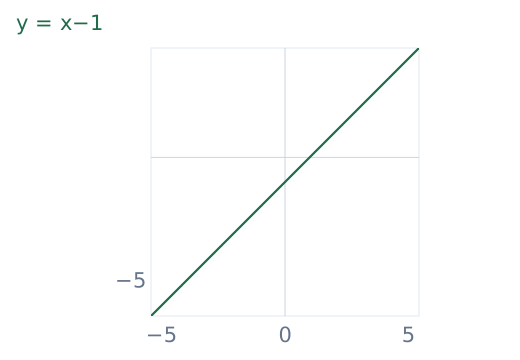
Q13. Find the complete set of values of k for which the line y = x − 1 crosses or touches the curve y = x2 + kx + 5.
Free · correct letter only
Answer
Answer: D. k ≤ 1 − 2√6 or k ≥ 1 + 2√6
The worked solution is part of the full bank. The question and the correct letter are free. Unlock the full bank
Q14. The real numbers a, b and c satisfy both 0 < a + 2b < c and 0 < a + 2c < b. Which of the following must be true? I: a < 0. II: b < c. III: a + b + c > 0.
Free · correct letter only
Answer
Answer: D. I and III only
The worked solution is part of the full bank. The question and the correct letter are free. Unlock the full bank
Q15. Let f(x) = ax³ + bx² + cx + d and g(x) = px³ + qx² + rx + s. If f(x) ≥ g(x) for every x ≥ 0, which of the following must be true? I: a ≥ p. II: d ≥ s. III: c ≥ r.
Free · correct letter only
Answer
Answer: C. I and II only
The worked solution is part of the full bank. The question and the correct letter are free. Unlock the full bank
Q16. Which of the following statements about a polynomial f with real coefficients are sufficient for f(x) = 0 to have a real solution? I: f(0) < 0 and the leading coefficient of f is positive. II: f(x) = x4 + ax + b for some real numbers a and b. III: f'(x) > 0 for every real x.
Free · correct letter only
Answer
Answer: B. I and III only
The worked solution is part of the full bank. The question and the correct letter are free. Unlock the full bank
Q17. A region R consists of all points (x, y) with x2 ≤ y ≤ x + 2. Which of the following is true for every point of R? I: 0 ≤ y ≤ 4. II: xy ≥ −1. III: y ≥ x.
Free · correct letter only
Answer
Answer: D. I and II only
The worked solution is part of the full bank. The question and the correct letter are free. Unlock the full bank
Q18. For how many real x does there exist a real y such that (x2 − 1)y + 1 is negative?
Free · correct letter only
Answer
Answer: D. all real x except exactly two
The worked solution is part of the full bank. The question and the correct letter are free. Unlock the full bank
Q19. Which describes the set of real x for which both |x + 2| < |x + 8| and |x + 8| < |x − 4| are true?
Free · correct letter only
Answer
Answer: C. an interval of length 3
The worked solution is part of the full bank. The question and the correct letter are free. Unlock the full bank
Q20. Given that 1/(√x − 4) − 1/(√x + 4) = 2/9, and √x > 4, what is the value of x?
Free · correct letter only
Answer
Answer: E. 52
The worked solution is part of the full bank. The question and the correct letter are free. Unlock the full bank
Q21. For which values of m does x⁴ − (m + 1)x² + m = 0 have four distinct real roots?
Free · correct letter only
Answer
Answer: A. m > 0 and m ≠ 1
The worked solution is part of the full bank. The question and the correct letter are free. Unlock the full bank
Q22. A polynomial p(x) satisfies p(1) = 4 and p(−2) = −5. Which of the following must be true?
Free · correct letter only
Answer
Answer: A. p(x) = (x − 1)(x + 2) q(x) + 3x + 1 for some polynomial q(x).
The worked solution is part of the full bank. The question and the correct letter are free. Unlock the full bank
Q23. The real numbers p and q satisfy p ≥ q. Consider these statements: 1. −q ≥ −p 2. pq ≥ q2 3. p + q ≥ 2q Which of them must be true?
Free · correct letter only
Answer
Answer: D. 1 and 3 only
The worked solution is part of the full bank. The question and the correct letter are free. Unlock the full bank
Q24. The positive real numbers a, b and c are such that x3 − a x2 + b x − c = 0 has three real roots, all positive. Which statement describes the real roots of x3 + a x2 + b x + c = 0?
Free · correct letter only
Answer
Answer: B. It has three real roots, all negative.
The worked solution is part of the full bank. The question and the correct letter are free. Unlock the full bank
Q25. For which real values of k does the equation |x − 1| = kx + 2 have exactly two distinct real solutions?
Free · correct letter only
Answer
Answer: C. −1 < k < 1
The worked solution is part of the full bank. The question and the correct letter are free. Unlock the full bank
Q26. Let p(x) = x4 + ax3 + bx2 + cx + 3, where a, b and c are nonzero integers, a is positive, and |b| > |c| > |a|. Dividing p(x) by x − 1 leaves remainder R, and dividing by x + 1 leaves remainder S. Given that S = 2R and S − R = 6, what is c?
Free · correct letter only
Answer
Answer: E. −4
The worked solution is part of the full bank. The question and the correct letter are free. Unlock the full bank
Q27. Find the value of √(31 + 12√3) − √(19 − 8√3).
Free · correct letter only
Answer
Answer: A. 4√3 − 2
The worked solution is part of the full bank. The question and the correct letter are free. Unlock the full bank
Q28. In the expansion of (2x³ + x⁻¹)⁶, which term has the greatest coefficient?
Free · correct letter only
Answer
Answer: B. 240x¹⁰
The worked solution is part of the full bank. The question and the correct letter are free. Unlock the full bank
Q29. Let n be a positive integer. For which n is x² − 1 a factor of x3n − 2xn + 1?
Free · correct letter only
Answer
Answer: C. Every even positive integer n
The worked solution is part of the full bank. The question and the correct letter are free. Unlock the full bank
Q30. Dividing x⁴ + ax³ + bx² + cx + 2 by x − 1 leaves remainder R, and dividing it by x + 1 leaves remainder S. If S − R = 10 and S = 3R, find b.
Free · correct letter only
Answer
Answer: A. 7
The worked solution is part of the full bank. The question and the correct letter are free. Unlock the full bank
Q31. Exactly one of the following claims has a counterexample among ordered pairs of real numbers (x, y). Which claim is it?
Free · correct letter only
Answer
Answer: E. If x > y, then x² > y²
The worked solution is part of the full bank. The question and the correct letter are free. Unlock the full bank
Q32. The functions f and g are defined by f(x) = x² − 4 and g(x) = x². How many distinct real solutions does g(f(x)) = 16 have?
Free · correct letter only
Answer
Answer: D. 3
The worked solution is part of the full bank. The question and the correct letter are free. Unlock the full bank
Q33. The polynomial p(x) = x⁴ + ax³ + bx² + cx + 5 leaves remainder R when divided by x − 1 and remainder S when divided by x + 1. If S − R = 12 and S = 4R, find b.
Free · correct letter only
Answer
Answer: E. 4
The worked solution is part of the full bank. The question and the correct letter are free. Unlock the full bank
Q34. A rectangle has perimeter 40, and one of its sides has length at least 14. What is the greatest possible area of the rectangle?
Free · correct letter only
Answer
Answer: B. 84
The worked solution is part of the full bank. The question and the correct letter are free. Unlock the full bank
Q35. The functions f and g are defined by f(x) = x² − 9 and g(x) = |x| − 2. For which values of the constant c does the equation f(g(x)) = c have exactly four real solutions?
Free · correct letter only
Answer
Answer: C. −9 < c < −5
The worked solution is part of the full bank. The question and the correct letter are free. Unlock the full bank
Q36. Dividing x⁴ + ax³ + bx² + cx + 2 by x − 1 leaves remainder R, and dividing it by x + 1 leaves remainder S. If S = 3R and S exceeds R by 8, what is b?
Free · correct letter only
Answer
Answer: D. 5
The worked solution is part of the full bank. The question and the correct letter are free. Unlock the full bank
Q37. Let f(x) = x² and let g(x) = x² − 3. How many real numbers x satisfy f(g(x)) = 1?
Free · correct letter only
Answer
Answer: D. 4
The worked solution is part of the full bank. The question and the correct letter are free. Unlock the full bank
Q38. Suppose r and s are positive integers satisfying 2r + s = 20. What is the greatest possible value of r² × s?
Free · correct letter only
Answer
Answer: A. 294
The worked solution is part of the full bank. The question and the correct letter are free. Unlock the full bank
Q39. The polynomial f(x) = x⁴ + px³ + qx² + rx + 4 leaves remainder R on division by x − 1 and remainder S on division by x + 1. If S = 3R and S − R = 16, what is q?
Free · correct letter only
Answer
Answer: A. 11
The worked solution is part of the full bank. The question and the correct letter are free. Unlock the full bank
Q40. The functions f and g are defined for all real x by f(x) = 2x + 3 and g(x) = x² + c, where c is a constant. For which value of c does the equation f(g(x)) = g(f(x)) have exactly one real solution?
Free · correct letter only
Answer
Answer: B. −12
The worked solution is part of the full bank. The question and the correct letter are free. Unlock the full bank
Q41. The polynomial p(x) = x³ + ax² + bx − 6 has x − 2 as a factor and leaves remainder −12 when divided by x + 1. Find a.
Free · correct letter only
Answer
Answer: B. −2
The worked solution is part of the full bank. The question and the correct letter are free. Unlock the full bank
Q42. The functions f and g are given by f(x) = x³ − x and g(x) = x + 1. How many real solutions does f(g(x)) = 0 have?
Free · correct letter only
Answer
Answer: D. 3
The worked solution is part of the full bank. The question and the correct letter are free. Unlock the full bank
Q43. Dividing p(x) = x⁴ + ax³ + bx² + cx + 5 by x − 1 leaves remainder R, and dividing it by x + 1 leaves remainder S. Given that S − R = 4 and S = 3R, find b.
Free · correct letter only
Answer
Answer: E. −2
The worked solution is part of the full bank. The question and the correct letter are free. Unlock the full bank
Q44. Let f(x) = x² − 2x. How many distinct real numbers x satisfy f(f(x)) = 3?
Free · correct letter only
Answer
Answer: B. 3
The worked solution is part of the full bank. The question and the correct letter are free. Unlock the full bank
Q45. The polynomial p(x) = x⁴ + ax³ + bx² + cx + 3 leaves remainder R on division by x − 1 and remainder S on division by x + 1. Given that S − R = 6 and S = 3R, what is b?
Free · correct letter only
Answer
Answer: D. 2
The worked solution is part of the full bank. The question and the correct letter are free. Unlock the full bank
Q46. The functions f and g are defined by f(x) = x² and g(x) = x² − 5. How many real solutions does f(g(x)) = 36 have?
Free · correct letter only
Answer
Answer: D. 2
The worked solution is part of the full bank. The question and the correct letter are free. Unlock the full bank
Q47. For how many positive integers n is n² < 9n + 52?
Free · correct letter only
Answer
Answer: E. 12
The worked solution is part of the full bank. The question and the correct letter are free. Unlock the full bank
Q48. The polynomial x3 + a x2 + b x − 6 has (x − 1) and (x + 2) as factors, where a and b are constants. What is the value of a?
Free · correct letter only
Answer
Answer: D. 4
The worked solution is part of the full bank. The question and the correct letter are free. Unlock the full bank
Q49. For how many integers k does the equation x2 − kx + 2k = 0 have real solutions that are all integers?
Free · correct letter only
Answer
Answer: A. 4
The worked solution is part of the full bank. The question and the correct letter are free. Unlock the full bank
Q50. For which real numbers x is x/(x2 + 1) ≤ 1/4?
Free · correct letter only
Answer
Answer: D. x ≤ 2 − √3 or x ≥ 2 + √3
The worked solution is part of the full bank. The question and the correct letter are free. Unlock the full bank
Q51. For which real values of a does the equation ax2 − 2x + (a − 1) = 0 have at least one real solution? When a = 0, read the equation as the remaining linear equation.
Free · correct letter only
Answer
Answer: B. (1 − √5)/2 ≤ a ≤ (1 + √5)/2
The worked solution is part of the full bank. The question and the correct letter are free. Unlock the full bank
Q52. Which term has the greatest coefficient in the expansion of (3x2 + 2/x)6?
Free · correct letter only
Answer
Answer: C. 4860x6
The worked solution is part of the full bank. The question and the correct letter are free. Unlock the full bank
Q53. The curve y = √x and the line y = (x + 3)/4 intersect at two points. What is the sum of the x-coordinates of those points?
Free · correct letter only
Answer
Answer: C. 10
The worked solution is part of the full bank. The question and the correct letter are free. Unlock the full bank