
Question 1Integration
TMUA Integration — Practice Questions by Topic
These are SummitPapers original questions, not official past paper questions. Official TMUA questions sorted by topic are on TMUA past papers by topic.
- MM7Integration
- 114 questions78 on Paper 1 · 36 on Paper 2
- 9 free solutionsThe rest show the correct letter only
Covers: definite integrals, areas between a curve and a line, the trapezium rule, recognising a derivative inside an integral.
What this topic tests
Integration here means definite integrals, the area between a curve and a line, the trapezium rule, and recognising a derivative inside an integral.
How it is assessed
This is Section 1, on both papers in this set. Each question has five options. A paper is 20 questions in 75 minutes, with no calculator.
This note is written for SummitPapers. The official list of what can be examined is the specification, together with the Notes on Mathematics and, for Paper 2, the Notes on Logic and Proof.
Key methods
A definite integral is a signed area
Where the curve is below the axis, the integral is negative. An area asked for as a region is the absolute value of those pieces, added. A question that says “integral” wants the signed value.
The trapezium rule
With n strips of width h, the rule weights the first and last heights once and the heights in between twice, then multiplies by h/2. Missing the factor 1/2, or the double weight, is a different number.
Common mistakes
Forgetting the chain
The integral of f'(g(x)) g'(x) is f(g(x)). Integrating f'(g(x)) without the inner derivative leaves a missing factor.
Limits in the wrong order
Swapping the limits changes the sign. An area between a curve and a line uses the difference of the functions, with the upper curve first on each piece.
Worked example
This question is also in the list below, with the solution folded. It is opened here so the method is on the page before the other questions.
Find the area of the finite region bounded by the curve y = x2 + 3x, the x-axis and the line x = 2. Take the region where 0 ≤ x ≤ 2.
Answer: A. 26/3
Worked solution. On 0 ≤ x ≤ 2 the curve is on or above the x-axis, so the area is the integral of x2 + 3x from 0 to 2. An antiderivative is x3/3 + (3/2)x2. At x = 2 this is 8/3 + 6 = 8/3 + 18/3 = 26/3, and the value at 0 is 0. The area is 26/3.
Why the other options look right. B integrates x2 and drops 3x, leaving 8/3. C multiplies the value of the curve at x = 2 by the width 2, giving (4 + 6) × 2 = 20. D integrates 3x and drops x2, leaving (3/2) × 4 = 6. E integrates x2 as x3, so the value at 2 is 8 + 6 = 14.
Paper 1 questions
Paper 1 is Applications of Mathematical Knowledge. Calculators are not allowed.
Q1. A curve has gradient dy/dx = 2xy − 6x and passes through (0, 5). Express y in terms of x.
Free · worked solution included
Answer and worked solution
Answer: A. 2ex² + 3
Worked solution. Factorise the gradient: dy/dx = 2x(y − 3). The curve passes through y = 5, so y ≠ 3 and the variables can be separated: the integral of 1/(y − 3) with respect to y equals the integral of 2x with respect to x, so ln|y − 3| = x² + C and y − 3 = A ex². Substituting x = 0 and y = 5 gives A + 3 = 5, so A = 2. Therefore y = 2ex² + 3. Check: dy/dx = 4x ex² and 2x(y − 3) = 2x × 2ex² = 4x ex².
Why the other options look right. B uses the y-value 5 at x = 0 as the coefficient of the exponential instead of solving A + 3 = 5, giving 5ex² + 3, which passes through (0, 8). C writes ex² + C as ex² + C, so y − 3 = ex² + C; the point (0, 5) gives C = 1 and y = ex² + 4. D factorises 2xy − 6x as 2x(y + 3), so y + 3 = A ex²; the point (0, 5) gives A = 8 and y = 8ex² − 3. E integrates 2x as 2x² instead of x², so y − 3 = A e2x² and the point (0, 5) gives y = 2e2x² + 3.
Q2. Water enters a tank at 2t2 − t litres per minute, where t is the number of minutes after a valve is opened. The rate is positive for t ≥ 1. How many litres enter between t = 1 and t = 4?
Free · worked solution included
Answer and worked solution
Answer: D. 69/2
Worked solution. The amount is the definite integral of 2t2 − t from 1 to 4. An antiderivative is (2/3)t3 − (1/2)t2. At t = 4 this is 128/3 − 8 = 104/3, and at t = 1 it is 2/3 − 1/2 = 1/6. The difference is 104/3 − 1/6 = 207/6 = 69/2.
Why the other options look right. A evaluates the antiderivative at 4 and subtracts the value at 0, leaving 104/3. B integrates −t as −t2, and [(2/3)t3 − t2] from 1 to 4 equals 27. C changes the sign of the integral of −t, and [(2/3)t3 + (1/2)t2] from 1 to 4 equals 99/2. E integrates 2t2 as t3, and [t3 − (1/2)t2] from 1 to 4 equals 111/2.
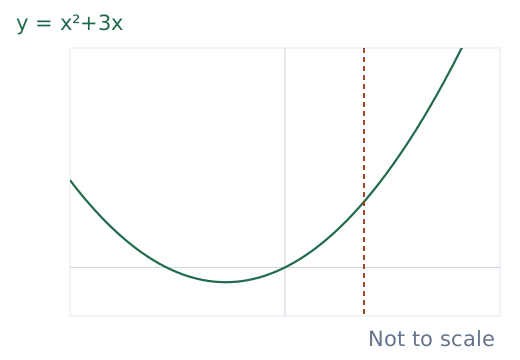
Q3. Find the area of the finite region bounded by the curve y = x2 + 3x, the x-axis and the line x = 2. Take the region where 0 ≤ x ≤ 2.
Free · worked solution included
Answer and worked solution
Answer: A. 26/3
Worked solution. On 0 ≤ x ≤ 2 the curve is on or above the x-axis, so the area is the integral of x2 + 3x from 0 to 2. An antiderivative is x3/3 + (3/2)x2. At x = 2 this is 8/3 + 6 = 8/3 + 18/3 = 26/3, and the value at 0 is 0. The area is 26/3.
Why the other options look right. B integrates x2 and drops 3x, leaving 8/3. C multiplies the value of the curve at x = 2 by the width 2, giving (4 + 6) × 2 = 20. D integrates 3x and drops x2, leaving (3/2) × 4 = 6. E integrates x2 as x3, so the value at 2 is 8 + 6 = 14.
Q4. The tangent to the curve y = x3 at the point (1, 1) meets the curve again at a second point. What is the area of the region enclosed by the curve and this tangent?
Free · worked solution included
Answer and worked solution
Answer: E. 27/4
Worked solution. The gradient is dy/dx = 3x2, which is 3 at x = 1, so the tangent is y − 1 = 3(x − 1), that is y = 3x − 2. The curve and the tangent meet where x3 − 3x + 2 = 0, which factorises as (x − 1)2(x + 2) = 0, so the second point is at x = −2. For −2 < x < 1 the difference x3 − (3x − 2) = (x − 1)2(x + 2) is positive, so the curve lies above the tangent. The area is the integral from −2 to 1 of (x3 − 3x + 2) dx = [x4/4 − 3x2/2 + 2x] from −2 to 1 = (1/4 − 3/2 + 2) − (4 − 6 − 4) = 3/4 + 6 = 27/4.
Why the other options look right. A integrates the tangent minus the curve, (3x − 2) − x3, from −2 to 1 and reports the negative signed value as the area. B integrates x3 − 3x + 2 only from 0 to 1. C takes the second meeting point as x = 2, from a sign slip in the factor x + 2, and integrates from 1 to 2. D finds the area between the curve y = x3 and the x-axis for −2 ≤ x ≤ 1, which is 4 + 1/4, instead of the area between the curve and the tangent.
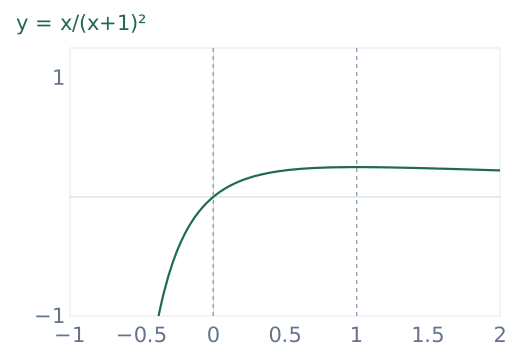
Q5. What is the value of the integral from 0 to 1 of x/(x + 1)2 dx?
Free · worked solution included
Answer and worked solution
Answer: D. ln 2 − 1/2
Worked solution. The derivative of ln(x + 1) + 1/(x + 1) is 1/(x + 1) − 1/(x + 1)2 = x/(x + 1)2. Evaluating from 0 to 1 gives (ln 2 + 1/2) − (0 + 1) = ln 2 − 1/2.
Why the other options look right. A evaluates only ln(x + 1) from 0 to 1. B ignores the numerator x and integrates 1/(x + 1)2 from 0 to 1, which gives 1 − 1/2 = 1/2. C forgets to subtract the lower-limit value 1, leaving ln 2 + 1/2. E reverses the limits.
Q6. What is the value of the integral from 0 to π of x sin x dx?
Free · worked solution included
Answer and worked solution
Answer: C. π
Worked solution. Let I be the integral. Replacing x by π − x gives I = the integral from 0 to π of (π − x) sin x dx, because sin(π − x) = sin x. Expanding, I = π times the integral of sin x, minus I. The integral of sin x from 0 to π is 2, so 2I = 2π and I = π.
Why the other options look right. A treats the contributions on either side of π/2 as cancelling. B is the integral of sin x from 0 to π, with the factor x omitted. D is 2I, the value obtained before dividing by 2. E takes that integral of sin x to be the length π, so the reflection step becomes 2I = π × π and I = π2/2.
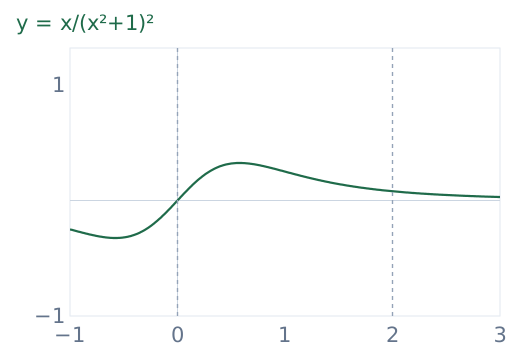
Q7. What is the value of the integral from 0 to 2 of x / (x2 + 1)2 dx?
Free · worked solution included
Answer and worked solution
Answer: C. 2/5
Worked solution. Let u = x2 + 1, so du = 2x dx. The limits change from x = 0 to x = 2 into u = 1 to u = 5. The integral becomes (1/2) times the integral of u−2 from 1 to 5, which is (1/2) [ −1/u ] from 1 to 5 = (1/2)(−1/5 + 1) = (1/2)(4/5) = 2/5. The same antiderivative in x is −1/(2(x2 + 1)), and evaluating it from 0 to 2 again gives −1/10 − (−1/2) = 2/5.
Why the other options look right. A drops the lower-limit term and evaluates only the antiderivative at the upper limit, −1/(2 × 5) = −1/10. B puts the factor 1/2 in twice, writing the antiderivative as −1/(4(x2 + 1)), which changes by −1/20 + 1/4 = 1/5 from 0 to 2. D drops the upper-limit term and computes 0 − (−1/2) = 1/2. E uses −1/(x2 + 1) as the antiderivative, omitting the factor 1/2, and that changes by 4/5 from 0 to 2.
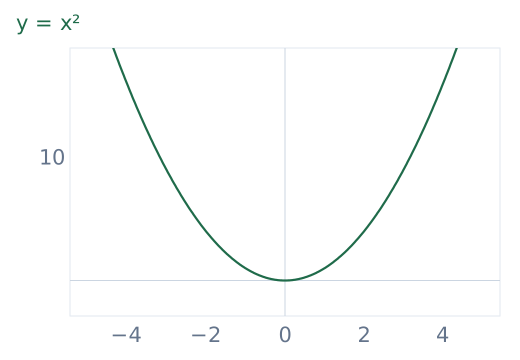
Q8. In the expansion of (x + 2/x)6, let a be the largest coefficient. The line y = (a/120)x and the curve y = x2 enclose one finite region. What is the area of that region?
Free · worked solution included
Answer and worked solution
Answer: B. 4/3
Worked solution. The general term of (x + 2/x)6 is C(6, k) x6 − k (2/x)k = C(6, k) 2k x6 − 2k. The coefficients C(6, k) 2k for k = 0 to 6 are 1, 12, 60, 160, 240, 192 and 64, so a = 240. The line is y = 2x. It meets y = x2 where x2 = 2x, so x = 0 or x = 2. Between 0 and 2 the line is above the curve, and this is the only finite enclosed region. The area is the integral from 0 to 2 of (2x − x2) dx = [x2 − x3/3] from 0 to 2 = 4 − 8/3 = 4/3.
Why the other options look right. A takes the line to meet the curve at x = 1 instead of x = 2, and integrates 2x − x2 from 0 to 1, which gives 1 − 1/3 = 2/3. C reports the x-coordinate 2 of the second intersection point instead of the area. D is the integral of x2 alone from 0 to 2. E is the integral of the line alone, which is [x2] from 0 to 2 = 4.
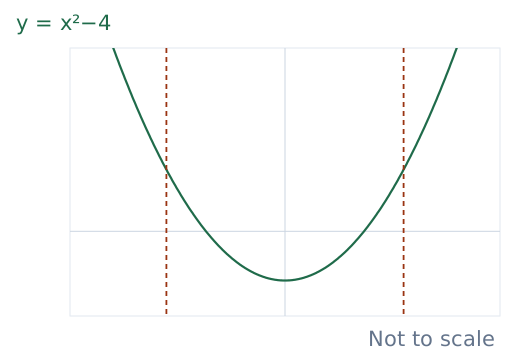
Q9. Find the area of the region enclosed by the curve y = x2 − 4, the x-axis and the lines x = −3 and x = 3.
Free · correct letter only
Answer
Answer: C. 46/3
The worked solution is part of the full bank. The question and the correct letter are free. Unlock the full bank
Q10. A curve satisfies dy/dx = 6x2 − 4x−3 + 2x−2 for x not equal to 0, and y = 9 when x = 1. Which expression gives y?
Free · correct letter only
Answer
Answer: C. 2x3 + 2x−2 − 2x−1 + 7
The worked solution is part of the full bank. The question and the correct letter are free. Unlock the full bank
Q11. The function f satisfies f(x) > 0 for every real x, and the integral from 1 to 4 of f(x) dx equals K. Which one of the following must be true?
Free · correct letter only
Answer
Answer: B. The integral from 0 to 3 of [f(x + 1) + 2] dx equals K + 6
The worked solution is part of the full bank. The question and the correct letter are free. Unlock the full bank
Q12. Evaluate the integral from 1 to 9 of (4 − 3x) / (x√x) dx.
Free · correct letter only
Answer
Answer: C. −20/3
The worked solution is part of the full bank. The question and the correct letter are free. Unlock the full bank
Q13. The curve y = f(x) is given by f(x) = x(x − p)(x − q)(r − x), where 0 < p < q < r. The total area enclosed by the curve and the x-axis for 0 ≤ x ≤ r is 24. The integral of f from 0 to r is 2, and the integral from 0 to q is −5. What is the integral of f from p to r?
Free · correct letter only
Answer
Answer: B. −4
The worked solution is part of the full bank. The question and the correct letter are free. Unlock the full bank
Q14. The trapezium rule with two strips of equal width is used to estimate the integral from 0 to 2 of g(x) dx. For which of the following functions g is the estimate exactly equal to the integral?
Free · correct letter only
Answer
Answer: C. g(x) = (x − 1)³
The worked solution is part of the full bank. The question and the correct letter are free. Unlock the full bank
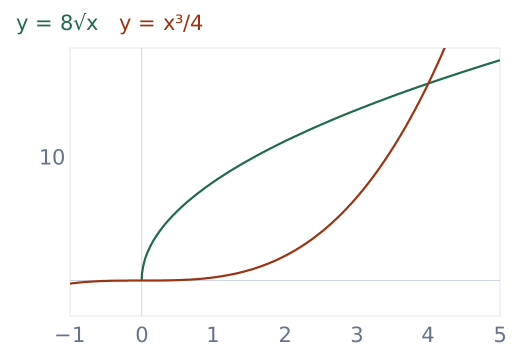
Q15. Find the area enclosed between the curves y = 8√x and y = x³/4.
Free · correct letter only
Answer
Answer: D. 80/3
The worked solution is part of the full bank. The question and the correct letter are free. Unlock the full bank
Q16. For each x, let m(x) be the larger of x² and 3x − 2. What is the integral from 0 to 2 of m(x) dx?
Free · correct letter only
Answer
Answer: E. 17/6
The worked solution is part of the full bank. The question and the correct letter are free. Unlock the full bank
Q17. It is given that dy/dx = 1/(√x(1 + √x)²) for x > 0, and that y = 2 when x = 1. What is y when x = 9?
Free · correct letter only
Answer
Answer: D. 5/2
The worked solution is part of the full bank. The question and the correct letter are free. Unlock the full bank
Q18. Suppose that 3 times the integral from 0 to 1 of f(x) dx, plus 2 times the integral from 1 to 2 of f(x) dx, equals 5. Also, the integral from 0 to 1 of f(x + 1) dx equals 4. What is the integral from 0 to 2 of f(x) dx?
Free · correct letter only
Answer
Answer: C. 3
The worked solution is part of the full bank. The question and the correct letter are free. Unlock the full bank
Q19. The curve y = x2 − c, where 0 < c < 9, crosses the positive x-axis at x = √c. Let R be the area between the curve and the x-axis from x = 0 to x = √c, and let S be the area between the curve and the x-axis from x = √c to x = 3. For which value of c are these two areas equal?
Free · correct letter only
Answer
Answer: A. 3
The worked solution is part of the full bank. The question and the correct letter are free. Unlock the full bank
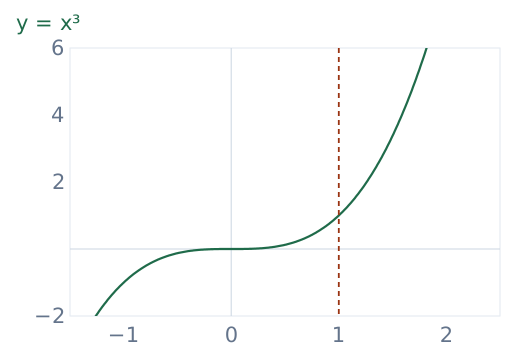
Q20. For m > 0, the line y = mx and the curve y = x3 enclose a region in the first quadrant. This region has the same area as the triangle bounded by the line y = mx, the x-axis and the line x = 1. What is the value of m?
Free · correct letter only
Answer
Answer: C. 2
The worked solution is part of the full bank. The question and the correct letter are free. Unlock the full bank
Q21. A continuous function f satisfies f(x) + f(4 − x) = x2 − 4x + 10 for 0 ≤ x ≤ 4. What is the value of the integral of f(x) from 0 to 4?
Free · correct letter only
Answer
Answer: A. 44/3
The worked solution is part of the full bank. The question and the correct letter are free. Unlock the full bank
Q22. The function f is odd, so f(−x) = −f(x) for every x. The integral from 0 to 2 of f(x) dx equals 3, and the integral from 0 to 2 of (f(x))² dx equals 6. What is the integral from −2 to 2 of (f(x) + 1)(f(−x) + 4) dx?
Free · correct letter only
Answer
Answer: E. 4
The worked solution is part of the full bank. The question and the correct letter are free. Unlock the full bank
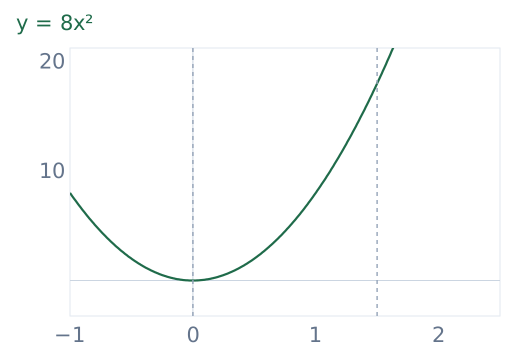
Q23. Use the trapezium rule with 3 strips to estimate the integral from 0 to 3/2 of 8x2 dx.
Free · correct letter only
Answer
Answer: C. 19/2
The worked solution is part of the full bank. The question and the correct letter are free. Unlock the full bank
Q24. For every integer n ≥ 0, the integral from n to n + 1 of f(x) dx equals 2n + 1. Evaluate the sum from r = 1 to 6 of the integral from 0 to r of f(x) dx.
Free · correct letter only
Answer
Answer: B. 91
The worked solution is part of the full bank. The question and the correct letter are free. Unlock the full bank
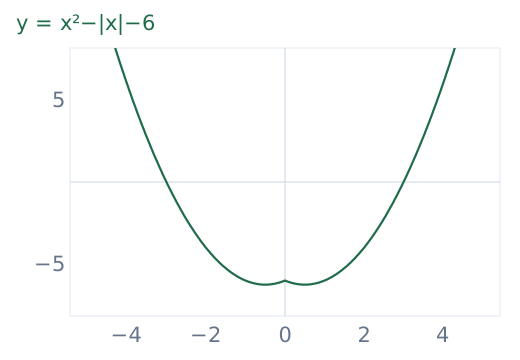
Q25. Find the finite area enclosed by the curve y = x2 − |x| − 6 and the x-axis.
Free · correct letter only
Answer
Answer: A. 27
The worked solution is part of the full bank. The question and the correct letter are free. Unlock the full bank
Q26. The integrals from 0 to 2 of (px + q) dx and of x(px + q) dx are 10 and 12 respectively. Find 2p + q.
Free · correct letter only
Answer
Answer: D. 8
The worked solution is part of the full bank. The question and the correct letter are free. Unlock the full bank
Q27. For every integer n ≥ 0, the integral of f from n to n + 1 equals 3n + 1. Evaluate the sum of the integrals of f from 0 to 2, from 1 to 2, from 3 to 2, and from 4 to 2.
Free · correct letter only
Answer
Answer: E. −15
The worked solution is part of the full bank. The question and the correct letter are free. Unlock the full bank
Q28. The trapezium rule with 2 strips is used to estimate the integral from 0 to 4 of √x dx. What is the positive difference between the estimate and the exact value?
Free · correct letter only
Answer
Answer: A. 10/3 − 2√2
The worked solution is part of the full bank. The question and the correct letter are free. Unlock the full bank
Q29. The function F satisfies dF/dx = x|x| for every real x, and F(0) = 0. Which expression is F(x)?
Free · correct letter only
Answer
Answer: D. |x|³/3
The worked solution is part of the full bank. The question and the correct letter are free. Unlock the full bank
Q30. As the real number a varies, what is the smallest possible value of the integral from 0 to 1 of (x2 − a)2 dx?
Free · correct letter only
Answer
Answer: A. 4/45
The worked solution is part of the full bank. The question and the correct letter are free. Unlock the full bank
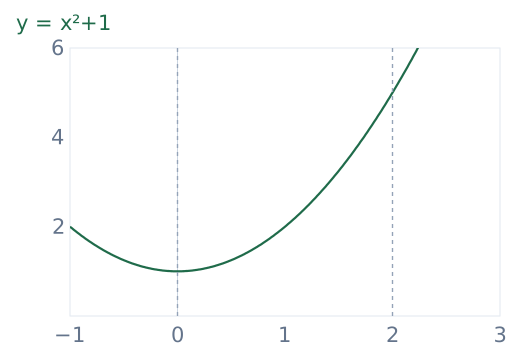
Q31. Evaluate the integral from 0 to 2 of (x² + 1) dx.
Free · correct letter only
Answer
Answer: D. 14/3
The worked solution is part of the full bank. The question and the correct letter are free. Unlock the full bank
Q32. Evaluate ∫ from 1 to 3 of 2x dx.
Free · worked solution included
Answer and worked solution
Answer: C. 8
Worked solution. An antiderivative of 2x is x². Evaluating from 1 to 3 gives 3² − 1² = 9 − 1 = 8.
Why the other options look right. A evaluates 2x at the limits without integrating, giving 2(3) − 2(1) = 6 − 2 = 4. B is just the integrand's value at the upper limit, 2 × 3 = 6, instead of a difference of antiderivative values. D is the value of x² at the upper limit only, 3² = 9, ignoring the lower limit. E takes the antiderivative of 2x as 2x², forgetting to divide by the new power 2, so 2(3²) − 2(1²) = 18 − 2 = 16.
Q33. For a positive integer n, let floor(x) be the greatest integer less than or equal to x. The integral from 0 to n of [3n − log base 3 of ((floor(x) + 1)2)] dx equals which expression?
Free · correct letter only
Answer
Answer: D. n × 3n − 2 log base 3 of n!
The worked solution is part of the full bank. The question and the correct letter are free. Unlock the full bank
Q34. Which of the following integrals has the greatest value?
Free · correct letter only
Answer
Answer: C. the integral from π/6 to π/3 of 6 sin x dx
The worked solution is part of the full bank. The question and the correct letter are free. Unlock the full bank
Q35. A function f satisfies the following three equations. The integral from 0 to 7 of f(x) dx equals 9. The integral from −3 to 7 of f(x) dx equals 15. The integral from −7 to 4 of f(−x) dx equals 2. What is the integral from 0 to −4 of f(x) dx?
Free · correct letter only
Answer
Answer: E. 7
The worked solution is part of the full bank. The question and the correct letter are free. Unlock the full bank
Q36. The constant k is greater than 1, and the integral from 1 to k of (2x − 3) dx equals 6. Find k.
Free · correct letter only
Answer
Answer: E. 4
The worked solution is part of the full bank. The question and the correct letter are free. Unlock the full bank
Q37. Evaluate the definite integral of x(2 − x)² from 0 to 1.
Free · correct letter only
Answer
Answer: D. 11/12
The worked solution is part of the full bank. The question and the correct letter are free. Unlock the full bank
Q38. Find the value of the integral from −1 to 1 of (x³ + 6x²) dx.
Free · correct letter only
Answer
Answer: D. 4
The worked solution is part of the full bank. The question and the correct letter are free. Unlock the full bank
Q39. Find the value of the integral from 0 to 1 of x²(1 − x)² dx.
Free · correct letter only
Answer
Answer: C. 1/30
The worked solution is part of the full bank. The question and the correct letter are free. Unlock the full bank
Q40. Evaluate the integral from −3 to 3 of (x⁵ − 4x³ + 2x²) dx.
Free · correct letter only
Answer
Answer: C. 36
The worked solution is part of the full bank. The question and the correct letter are free. Unlock the full bank
Q41. Evaluate the integral from 1 to 2 of x(2 − x)³ dx.
Free · correct letter only
Answer
Answer: A. 3/10
The worked solution is part of the full bank. The question and the correct letter are free. Unlock the full bank
Q42. Evaluate the integral of (x³ + 2)/x² with respect to x, from x = 1 to x = 2.
Free · correct letter only
Answer
Answer: E. 5/2
The worked solution is part of the full bank. The question and the correct letter are free. Unlock the full bank
Q43. Find the value of the integral from x = 1 to x = 2 of (2x − 1)² dx.
Free · correct letter only
Answer
Answer: C. 13/3
The worked solution is part of the full bank. The question and the correct letter are free. Unlock the full bank
Q44. Find the integral of x³ + x² between x = −3 and x = 3.
Free · correct letter only
Answer
Answer: A. 18
The worked solution is part of the full bank. The question and the correct letter are free. Unlock the full bank
Q45. Find the integral of x²(1 − x)³ between x = 0 and x = 1.
Free · correct letter only
Answer
Answer: E. 1/60
The worked solution is part of the full bank. The question and the correct letter are free. Unlock the full bank
Q46. Evaluate the integral of (2x − 1)(x + 2) from x = 1 to x = 3.
Free · correct letter only
Answer
Answer: B. 76/3
The worked solution is part of the full bank. The question and the correct letter are free. Unlock the full bank
Q47. Evaluate the integral of (2x + 1)³ from x = 0 to x = 1.
Free · correct letter only
Answer
Answer: E. 10
The worked solution is part of the full bank. The question and the correct letter are free. Unlock the full bank
Q48. Evaluate the integral from −1 to 1 of (x⁵ + 9x²) dx.
Free · correct letter only
Answer
Answer: C. 6
The worked solution is part of the full bank. The question and the correct letter are free. Unlock the full bank
Q49. Evaluate the integral from 0 to 1 of x²(1 − x)⁴ dx.
Free · correct letter only
Answer
Answer: D. 1/105
The worked solution is part of the full bank. The question and the correct letter are free. Unlock the full bank
Q50. What is the value of the integral from 1 to 4 of (6√x − 5/√x) dx?
Free · correct letter only
Answer
Answer: B. 18
The worked solution is part of the full bank. The question and the correct letter are free. Unlock the full bank
Q51. Which of these five integrals has the greatest value?
Free · correct letter only
Answer
Answer: D. the integral from 0 to 2 of (8 − x) dx
The worked solution is part of the full bank. The question and the correct letter are free. Unlock the full bank
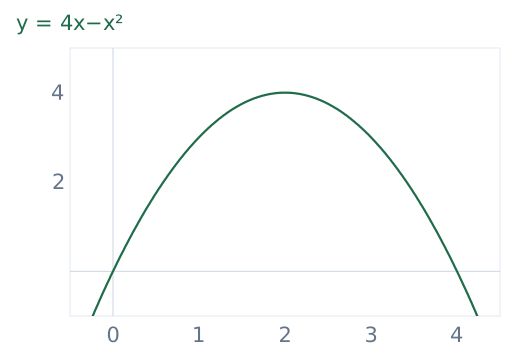
Q52. The line y = c, where 0 < c < 4, divides the region under y = 4x − x2 and above the x-axis into two regions of equal area. What is c?
Free · correct letter only
Answer
Answer: C. 4 − 42/3
The worked solution is part of the full bank. The question and the correct letter are free. Unlock the full bank
Q53. Find the value of the integral from 1 to 4 of (6√x + 32/x3) dx.
Free · correct letter only
Answer
Answer: C. 43
The worked solution is part of the full bank. The question and the correct letter are free. Unlock the full bank
Q54. Evaluate the integral from 0 to 6 of x|x − 3| dx.
Free · correct letter only
Answer
Answer: A. 27
The worked solution is part of the full bank. The question and the correct letter are free. Unlock the full bank
Q55. The function f satisfies f(x) > 0 for every real x. The integral of f from 1 to 3 equals P, and the integral of f from 3 to 7 equals Q. Find the integral from −1 to 5 of (f(x + 2) + 3) dx, in terms of P and Q.
Free · correct letter only
Answer
Answer: C. P + Q + 18
The worked solution is part of the full bank. The question and the correct letter are free. Unlock the full bank
Q56. What is the value of the integral from −2 to 2 of (x3 + 5x) / (x2 + 1) dx?
Free · correct letter only
Answer
Answer: A. 0
The worked solution is part of the full bank. The question and the correct letter are free. Unlock the full bank
Q57. Let n be a positive integer, and write floor(t) for the greatest integer less than or equal to t. What is the integral from 1 to 2n of floor(log2 x) dx?
Free · correct letter only
Answer
Answer: D. (n − 2)2n + 2
The worked solution is part of the full bank. The question and the correct letter are free. Unlock the full bank
Q58. Which of these integrals has the largest value?
Free · correct letter only
Answer
Answer: E. the integral from 0 to π/3 of 1 dx
The worked solution is part of the full bank. The question and the correct letter are free. Unlock the full bank
Q59. A function f satisfies the integral from 0 to 4 of f(x) dx = 10, the integral from −2 to 0 of f(x) dx = 3, and the integral from 2 to 4 of f(−x) dx = 5. What is the integral from −4 to 0 of f(x) dx?
Free · correct letter only
Answer
Answer: C. 8
The worked solution is part of the full bank. The question and the correct letter are free. Unlock the full bank
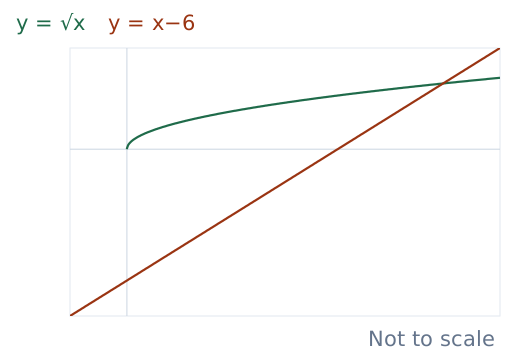
Q60. Find the area of the region bounded by the curve y = √x, the line y = x − 6 and the x-axis.
Free · correct letter only
Answer
Answer: D. 27/2
The worked solution is part of the full bank. The question and the correct letter are free. Unlock the full bank
Q61. Find the area of the finite region between the curve y = 2x² − 3 and the line y = x.
Free · correct letter only
Answer
Answer: D. 125/24
The worked solution is part of the full bank. The question and the correct letter are free. Unlock the full bank
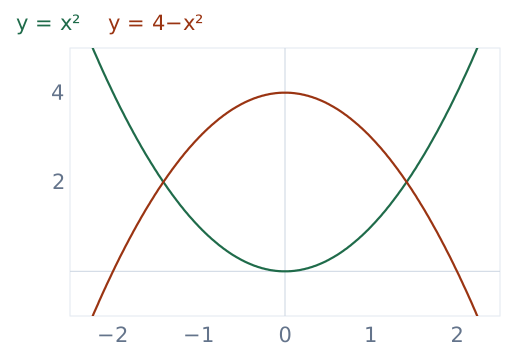
Q62. Find the area of the finite region between the curves y = x² and y = 4 − x².
Free · correct letter only
Answer
Answer: E. 16√2/3
The worked solution is part of the full bank. The question and the correct letter are free. Unlock the full bank
Q63. Find the area of the finite region bounded by the curve y = 8/x², the line y = x and the line x = 4.
Free · correct letter only
Answer
Answer: C. 4
The worked solution is part of the full bank. The question and the correct letter are free. Unlock the full bank
Q64. A line is tangent to the curve y = √x at the point (a², a), where a > 0. Find the area of the finite region bounded by the curve, the tangent and the x-axis.
Free · correct letter only
Answer
Answer: E. a³/3
The worked solution is part of the full bank. The question and the correct letter are free. Unlock the full bank
Q65. The area of the finite region between the parabolas y = x² + 3ax + a and y = a − 2x² equals 4. Find the possible values of a.
Free · correct letter only
Answer
Answer: A. a = ±2
The worked solution is part of the full bank. The question and the correct letter are free. Unlock the full bank
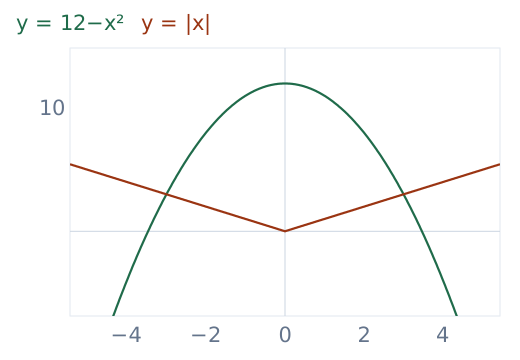
Q66. Find the area of the finite region between the curves y = 12 − x² and y = |x|.
Free · correct letter only
Answer
Answer: C. 45
The worked solution is part of the full bank. The question and the correct letter are free. Unlock the full bank
Q67. Evaluate ∫ from −1 to 2 of [3(x + |x|) − 2x|x|] dx.
Free · correct letter only
Answer
Answer: E. 22/3
The worked solution is part of the full bank. The question and the correct letter are free. Unlock the full bank
Q68. The positive number k satisfies ∫ from 0 to k of (√x + x²) dx = 8/3. Find k.
Free · correct letter only
Answer
Answer: B. 22/3
The worked solution is part of the full bank. The question and the correct letter are free. Unlock the full bank
Q69. Let f(x) = ∫ from 0 to x of 2t dt, and let g(x) = ∫ from 0 to 1 of xt dt. Which statement is true?
Free · correct letter only
Answer
Answer: D. g(f(p)) > f(g(p)) for every p > 0
The worked solution is part of the full bank. The question and the correct letter are free. Unlock the full bank
Q70. For 0 ≤ t ≤ 3, define f(t) = ∫ from 0 to 3 of |x − t| dx. Find the minimum value of f(t).
Free · correct letter only
Answer
Answer: C. 9/4
The worked solution is part of the full bank. The question and the correct letter are free. Unlock the full bank
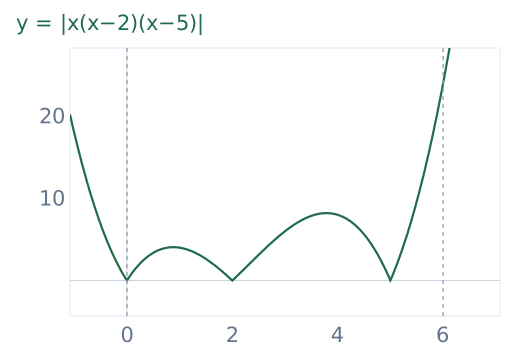
Q71. The trapezium rule with three trapezia is used to estimate ∫ from 0 to 6 of |x(x − 2)(x − 5)| dx. What value does the rule give?
Free · correct letter only
Answer
Answer: B. 40
The worked solution is part of the full bank. The question and the correct letter are free. Unlock the full bank
Q72. Find the total area of the two finite regions enclosed between the curve y = x(x − a)(x − 3a), where a > 0, and the x-axis.
Free · correct letter only
Answer
Answer: A. 37a⁴/12
The worked solution is part of the full bank. The question and the correct letter are free. Unlock the full bank
Q73. The function f satisfies f(x) + 2f(−x) = 1 + x² ∫ from −1 to 1 of f(u) du for every x. Find ∫ from −1 to 1 of f(x) dx.
Free · correct letter only
Answer
Answer: A. 6/7
The worked solution is part of the full bank. The question and the correct letter are free. Unlock the full bank
Q74. Place the following integrals in order of size, from smallest to largest. P = ∫ from 0 to 1 of ex dx, Q = ∫ from 0 to 1 of ex/2 dx, R = ∫ from 0 to 1 of e2x dx.
Free · correct letter only
Answer
Answer: C. Q < P < R
The worked solution is part of the full bank. The question and the correct letter are free. Unlock the full bank
Q75. Let f(x) = | |x − 1| − |x − 5| |, the absolute value of |x − 1| − |x − 5|. What is the integral from 0 to 6 of f(x) dx?
Free · correct letter only
Answer
Answer: D. 16
The worked solution is part of the full bank. The question and the correct letter are free. Unlock the full bank
Q76. The continuous function f satisfies f(x) = f(6 − x) for every real x. Suppose (the integral from 2 to 3 of f)² + (the integral from 4 to 6 of f)² + (the integral from 2 to 4 of f)(the integral from 0 to 2 of f) − 5(the integral from 3 to 6 of f) + 6 = 0. What is the sum of the possible values of the integral from 0 to 3 of f?
Free · correct letter only
Answer
Answer: C. 5
The worked solution is part of the full bank. The question and the correct letter are free. Unlock the full bank
Q77. Let {x} denote the fractional part of x. What is the integral from 0 to 3 of {2x} dx?
Free · correct letter only
Answer
Answer: C. 3/2
The worked solution is part of the full bank. The question and the correct letter are free. Unlock the full bank
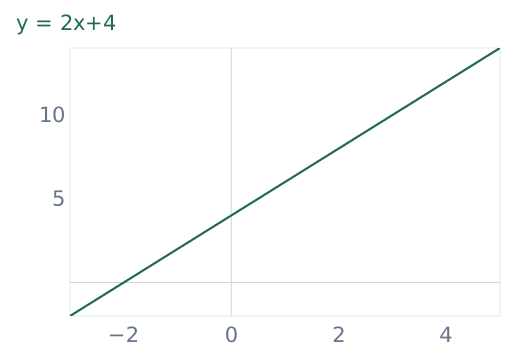
Q78. The integral from 0 to a of (2x + 4) dx equals 12, and a > 0. What is a?
Free · correct letter only
Answer
Answer: B. 2
The worked solution is part of the full bank. The question and the correct letter are free. Unlock the full bank
Paper 2 questions
Paper 2 is Mathematical Reasoning. It can test this same topic. Argument, proof, and identifying errors are the topics that appear on Paper 2 only.
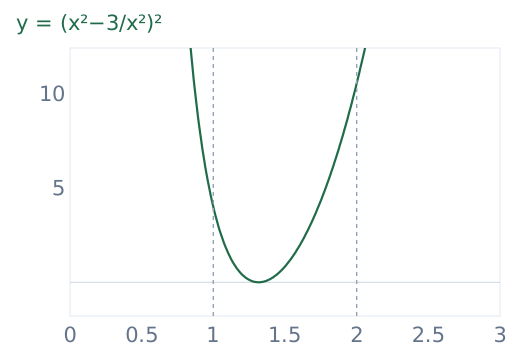
Q1. Evaluate the integral from 1 to 2 of (x2 − 3/x2)2 dx.
Free · correct letter only
Answer
Answer: C. 113/40
The worked solution is part of the full bank. The question and the correct letter are free. Unlock the full bank
Q2. The function f is increasing and f(0) = 0. The positive constants a and b satisfy a < b. The area of the region enclosed by y = f(x), the x-axis and the lines x = a and x = b is R. Define g(x) = f(x) + 3f(b). What is the area enclosed by y = g(x), the x-axis and the lines x = a and x = b?
Free · correct letter only
Answer
Answer: C. R + 3(b − a)f(b)
The worked solution is part of the full bank. The question and the correct letter are free. Unlock the full bank
Q3. The trapezium rule with 6 strips is used to approximate each of the following integrals. Which approximation is an overestimate?
Free · correct letter only
Answer
Answer: B. the integral from π/4 to π/2 of cos² x dx
The worked solution is part of the full bank. The question and the correct letter are free. Unlock the full bank
Q4. The function f is continuous and strictly increasing for 0 ≤ x ≤ 2. Which of the following must be true? I: the integral from 0 to 1 of f(x) dx is less than the integral from 1 to 2 of f(x) dx. II: the integral from 0 to 2 of f(x) dx is at most 2f(1). III: 2f(0) < the integral from 0 to 2 of f(x) dx < 2f(2).
Free · correct letter only
Answer
Answer: A. I and III only
The worked solution is part of the full bank. The question and the correct letter are free. Unlock the full bank
Q5. The function f is continuous for all real x, and F(x) = the integral from 0 to x of f(t) dt. Which completion is correct? F has a local maximum at x = 2 ...
Free · correct letter only
Answer
Answer: E. ... only if f(2) = 0.
The worked solution is part of the full bank. The question and the correct letter are free. Unlock the full bank
Q6. A continuous function f satisfies the integral from 0 to 2 of (f(x))2 dx, plus 2, equals twice the integral from 0 to 2 of f(x) dx. Which of the following must be true? I: f(x) = 1 for every x with 0 ≤ x ≤ 2. II: the integral from 0 to 2 of f(x) dx equals 2. III: the integral from 0 to 2 of (f(x))2 dx equals 4.
Free · correct letter only
Answer
Answer: A. I and II only
The worked solution is part of the full bank. The question and the correct letter are free. Unlock the full bank
Q7. Find the value of the integral from 1 to 4 of (√x − 2)2/√x dx.
Free · correct letter only
Answer
Answer: A. 2/3
The worked solution is part of the full bank. The question and the correct letter are free. Unlock the full bank
Q8. Which of the following statements about polynomials f and g are true? I: If the integral from 0 to 1 of f(t) dt is at least the integral from 0 to 1 of g(t) dt, then f(x) ≥ g(x) for some x with 0 ≤ x ≤ 1. II: If f(0) = g(0) and f'(x) ≥ g'(x) for all x ≥ 0, then f(x) ≥ g(x) for all x ≥ 0. III: If f(x) ≥ g(x) for all x ≥ 0, then f(x)2 ≥ g(x)2 for all x ≥ 0.
Free · correct letter only
Answer
Answer: E. I and II only
The worked solution is part of the full bank. The question and the correct letter are free. Unlock the full bank
Q9. A sequence of functions is defined by f1(x) = 1 and fn+1(x) = 1 + (the integral from 0 to x of fn(t) dt) for n ≥ 1. What is the integral from 0 to 2 of f4(x) dx?
Free · correct letter only
Answer
Answer: B. 6
The worked solution is part of the full bank. The question and the correct letter are free. Unlock the full bank
Q10. Let P be the integral from 0 to 1 of 2x2 dx, Q the integral from 0 to 1 of 2x dx, and R the integral from 0 to 1 of (1 + x) dx. Which statement is correct?
Free · correct letter only
Answer
Answer: A. P < Q < R
The worked solution is part of the full bank. The question and the correct letter are free. Unlock the full bank
Q11. Evaluate the integral from 1 to 4 of (x + 1/√x)² dx, minus the integral from 1 to 4 of (x − 1/√x)² dx.
Free · correct letter only
Answer
Answer: B. 56/3
The worked solution is part of the full bank. The question and the correct letter are free. Unlock the full bank
Q12. The ceiling of x, written ceil(x), is x rounded up to the nearest integer. For example, ceil(π) = 4 and ceil(8) = 8. What is the value of the integral from 0 to 6 of 3ceil(x) dx?
Free · correct letter only
Answer
Answer: A. 1092
The worked solution is part of the full bank. The question and the correct letter are free. Unlock the full bank
Q13. Let f be a polynomial with real coefficients. For p < q, define J(p, q) to be the integral from p to q of (f(x) + f(−x)) dx. Which of these statements must be true? 1: If f is odd, then J(p, q) = 0 whenever p < q. 2: If f(x) ≥ 0 for every x ≥ 0, then J(p, q) ≥ 0 whenever 0 ≤ p < q. 3: J(p, q) = 0 for every p < q only if f is odd.
Free · correct letter only
Answer
Answer: E. 1 and 3 only
The worked solution is part of the full bank. The question and the correct letter are free. Unlock the full bank
Q14. The integral of (1 − |x|)(2 − x) with respect to x, from −1 to 1, equals
Free · correct letter only
Answer
Answer: D. 2
The worked solution is part of the full bank. The question and the correct letter are free. Unlock the full bank
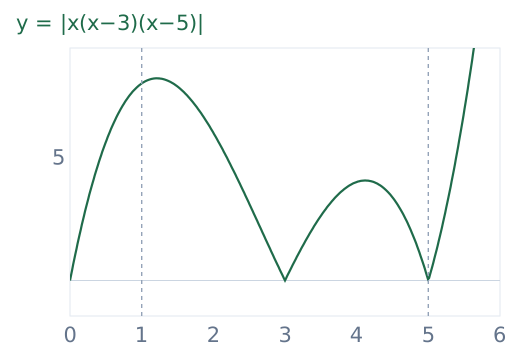
Q15. The trapezium rule with four strips is used to estimate the integral from 1 to 5 of |x(x − 3)(x − 5)| dx. The estimate equals
Free · correct letter only
Answer
Answer: B. 14
The worked solution is part of the full bank. The question and the correct letter are free. Unlock the full bank
Q16. Let floor(t) denote the greatest integer less than or equal to t. The value of the integral from 0 to 6 of (x + floor(x/3)) dx is
Free · correct letter only
Answer
Answer: C. 21
The worked solution is part of the full bank. The question and the correct letter are free. Unlock the full bank
Q17. Evaluate the integral from −1 to 3 of (|x| + |x − 2|) dx.
Free · correct letter only
Answer
Answer: D. 10
The worked solution is part of the full bank. The question and the correct letter are free. Unlock the full bank
Q18. The trapezium rule with 3 strips of equal width is applied on the interval [0, 3] to the integral of x² + k, where k is a constant, and gives the estimate 31/2. What is the exact value of the integral from 0 to 3 of (x² + k) dx?
Free · correct letter only
Answer
Answer: A. 15
The worked solution is part of the full bank. The question and the correct letter are free. Unlock the full bank
Q19. Evaluate the integral from 0 to 6 of |x − 2| dx.
Free · correct letter only
Answer
Answer: D. 10
The worked solution is part of the full bank. The question and the correct letter are free. Unlock the full bank
Q20. A function f has f(0) = 5, f(0.5) = 4, f(1) = 2, f(1.5) = 2 and f(2) = 1. Using only these values, the trapezium rule with 4 strips of equal width is applied to the integral from 0 to 2 of x f(x) dx. What estimate does it give?
Free · correct letter only
Answer
Answer: A. 4
The worked solution is part of the full bank. The question and the correct letter are free. Unlock the full bank
Q21. Evaluate the integral from 0 to 3 of |x² − 4| dx.
Free · correct letter only
Answer
Answer: B. 23/3
The worked solution is part of the full bank. The question and the correct letter are free. Unlock the full bank
Q22. For each positive integer n, let Tn be the estimate of the integral from 0 to 1 of x² dx given by the trapezium rule with n strips of equal width. What is the smallest n for which Tn − 1/3 < 1/100?
Free · correct letter only
Answer
Answer: C. 5
The worked solution is part of the full bank. The question and the correct letter are free. Unlock the full bank
Q23. What is the exact value of the integral of |x² − 2x| from x = 0 to x = 4?
Free · correct letter only
Answer
Answer: C. 8
The worked solution is part of the full bank. The question and the correct letter are free. Unlock the full bank
Q24. A function f takes the values f(0) = 3, f(1) = 5, f(2) = 4, f(3) = 6 and f(4) = 2. The integral of f(x) from 0 to 4 is estimated twice with the trapezium rule: once with 4 strips of equal width and once with 2 strips of equal width. By how much does the 4-strip estimate exceed the 2-strip estimate?
Free · correct letter only
Answer
Answer: E. 9/2
The worked solution is part of the full bank. The question and the correct letter are free. Unlock the full bank
Q25. Find the value of the integral from 0 to 5 of |x − 1| dx.
Free · correct letter only
Answer
Answer: C. 17/2
The worked solution is part of the full bank. The question and the correct letter are free. Unlock the full bank
Q26. The trapezium rule with 4 strips of equal width is used to approximate the integral of 2x from 0 to 2. What value does the rule give?
Free · correct letter only
Answer
Answer: A. (9 + 6√2)/4
The worked solution is part of the full bank. The question and the correct letter are free. Unlock the full bank
Q27. Evaluate the integral of |x − 4| from x = 0 to x = 7.
Free · correct letter only
Answer
Answer: B. 25/2
The worked solution is part of the full bank. The question and the correct letter are free. Unlock the full bank
Q28. The trapezium rule with two strips of equal width is used to estimate the integral of √(x³ + 1) over the interval from 0 to 2. What estimate does it give?
Free · correct letter only
Answer
Answer: E. 2 + √2
The worked solution is part of the full bank. The question and the correct letter are free. Unlock the full bank
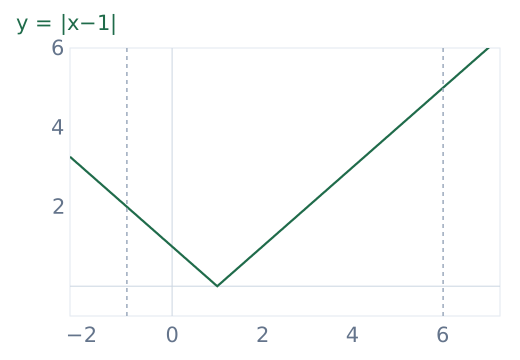
Q29. Evaluate the integral from −1 to 6 of |x − 1| dx.
Free · correct letter only
Answer
Answer: C. 29/2
The worked solution is part of the full bank. The question and the correct letter are free. Unlock the full bank
Q30. The trapezium rule with 4 strips of equal width is used to estimate the integral from 0 to π of sin x dx. What value does the rule give?
Free · correct letter only
Answer
Answer: A. π(1 + √2)/4
The worked solution is part of the full bank. The question and the correct letter are free. Unlock the full bank
Q31. The integral from 0 to x of (|t − 1| − 2) dt is zero for exactly one positive value of x. What is that value?
Free · correct letter only
Answer
Answer: A. 3 + √7
The worked solution is part of the full bank. The question and the correct letter are free. Unlock the full bank
Q32. The function f satisfies the integral from 0 to 2 of f(x) dx = 5, the integral from 1 to 4 of f(x) dx = 9, and the integral from 2 to 4 of f(x) dx = 6. What is the integral from 0 to 1 of f(x) dx?
Free · correct letter only
Answer
Answer: B. 2
The worked solution is part of the full bank. The question and the correct letter are free. Unlock the full bank
Q33. Which of these integrals has the largest value? You do not need to find the exact value of every integral.
Free · correct letter only
Answer
Answer: C. the integral from 0 to π of (2 + cos x) dx
The worked solution is part of the full bank. The question and the correct letter are free. Unlock the full bank
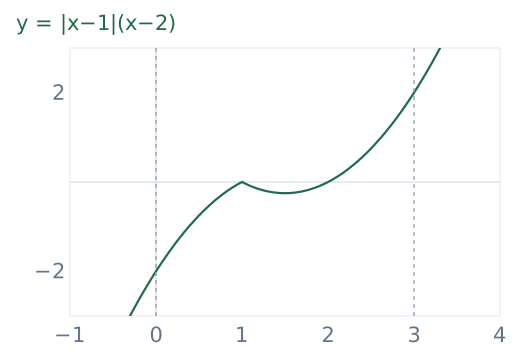
Q34. What is the value of the integral from 0 to 3 of |x − 1|(x − 2) dx?
Free · correct letter only
Answer
Answer: E. −1/6
The worked solution is part of the full bank. The question and the correct letter are free. Unlock the full bank
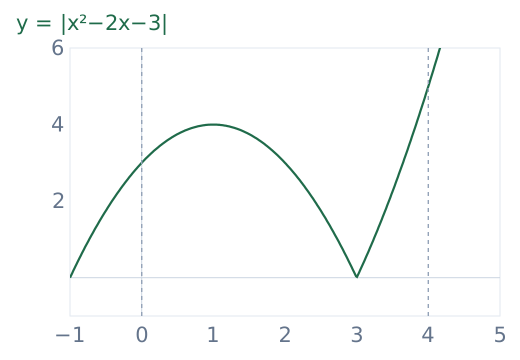
Q35. The trapezium rule with four trapezia is applied to the integral from 0 to 4 of |x2 − 2x − 3| dx. What value does it give?
Free · correct letter only
Answer
Answer: C. 11
The worked solution is part of the full bank. The question and the correct letter are free. Unlock the full bank
Q36. Let floor(t) denote the greatest integer less than or equal to t. What is the integral from 0 to 2 of floor(x2) dx?
Free · correct letter only
Answer
Answer: C. 5 − √2 − √3
The worked solution is part of the full bank. The question and the correct letter are free. Unlock the full bank