
Question 1Probability
TMUA Probability — Practice Questions by Topic
These are SummitPapers original questions, not official past paper questions. Official TMUA questions sorted by topic are on TMUA past papers by topic.
- M7Probability
- 26 questions22 on Paper 1 · 4 on Paper 2
- 8 free solutionsThe rest show the correct letter only
Covers: selection without replacement, independent trials, conditional probability, counting arrangements.
What this topic tests
Probability here means selection without replacement, independent trials, conditional probability, and counting arrangements. It is separate from statistics. Statistics on this site is the mean, the median, the mode, the range and the quartiles.
How it is assessed
This is Section 1, on both papers in this set. Each question has five options. A paper is 20 questions in 75 minutes, with no calculator.
This note is written for SummitPapers. The official list of what can be examined is the specification, together with the Notes on Mathematics and, for Paper 2, the Notes on Logic and Proof.
Key methods
Without replacement
The second draw is from what remains. The denominator drops by 1, and the numerator drops only if the first draw was of the type still being counted.
Conditional probability
The probability of A given B is the probability of both divided by the probability of B. The denominator is the condition, not the whole population.
Independent is not mutually exclusive
Independent events satisfy P(A and B) = P(A)P(B). Mutually exclusive events cannot happen together. Those are different. Events that cannot happen together are not independent, except in trivial cases.
Common mistakes
Order when the question ignores it
A committee is a combination. A queue, or a ranking, is a permutation. The question says whether the order is part of the outcome.
Adding probabilities that overlap
P(A or B) = P(A) + P(B) only when A and B cannot happen together. Otherwise the overlap is subtracted once.
Worked example
This question is also in the list below, with the solution folded. It is opened here so the method is on the page before the other questions.
A jar contains 16 red beads, 8 blue beads, and some white beads. A bead is drawn at random, and the probability that it is white is 1/3. How many white beads are in the jar?
Answer: C. 12
Worked solution. Let the number of white beads be w. Then w/(24 + w) = 1/3, so 3w = 24 + w and 2w = 24. Hence w = 12.
Why the other options look right. A ignores the 16 red beads and solves w/(8 + w) = 1/3, which gives 4. B ignores the 8 blue beads and solves w/(16 + w) = 1/3, which gives 8. D stops at 2w = 24 and reports 24 without dividing by 2. E reports the total number of beads, 16 + 8 + 12 = 36, instead of the number of white beads.
Paper 1 questions
Paper 1 is Applications of Mathematical Knowledge. Calculators are not allowed.
Q1. A jar contains 16 red beads, 8 blue beads, and some white beads. A bead is drawn at random, and the probability that it is white is 1/3. How many white beads are in the jar?
Free · worked solution included
Answer and worked solution
Answer: C. 12
Worked solution. Let the number of white beads be w. Then w/(24 + w) = 1/3, so 3w = 24 + w and 2w = 24. Hence w = 12.
Why the other options look right. A ignores the 16 red beads and solves w/(8 + w) = 1/3, which gives 4. B ignores the 8 blue beads and solves w/(16 + w) = 1/3, which gives 8. D stops at 2w = 24 and reports 24 without dividing by 2. E reports the total number of beads, 16 + 8 + 12 = 36, instead of the number of white beads.
Q2. A fair six-sided die is rolled twice. What is the probability that the larger of the two scores is 5?
Free · worked solution included
Answer and worked solution
Answer: A. 1/4
Worked solution. The outcome (a, b) has larger score 5 when both scores are at most 5 and at least one score is 5. The nine outcomes are (1, 5), (2, 5), (3, 5), (4, 5), (5, 1), (5, 2), (5, 3), (5, 4) and (5, 5). There are 36 equally likely outcomes, so the probability is 9/36 = 1/4.
Why the other options look right. B drops (5, 5), leaving 8/36 = 2/9. C counts only the five outcomes in which the first roll is 5 and the second roll is at most 5, giving 5/36. D counts the 6 outcomes with a 5 on the first die plus the 6 outcomes with a 5 on the second die, so it allows the other score to be 6 and counts (5, 5) twice: 12/36 = 1/3. E treats the larger score as if it were a single roll and gives P(score = 5) = 1/6.
Q3. Each item from a factory fails a test independently with probability 1/3. Four items are tested. What is the probability that exactly two of them fail?
Free · worked solution included
Answer and worked solution
Answer: B. 8/27
Worked solution. The number of failures is binomial with n = 4 and p = 1/3. Exactly two failures has probability C(4, 2) × (1/3)2 × (2/3)2 = 6 × (1/9) × (4/9) = 24/81 = 8/27.
Why the other options look right. A drops the binomial coefficient and computes only (1/3)2 × (2/3)2 = 4/81. C keeps just one factor of 2/3, giving 6 × (1/3)2 × (2/3) = 4/9. D is the probability of exactly one failure, 4 × (1/3) × (2/3)3 = 32/81. E uses a single factor of 1/3 instead of (1/3)2, giving 6 × (1/3) × (2/3)2 = 8/9.
Q4. A drawer holds 60 socks: 15 in each of the four colours red, blue, green and white. In every colour, 3 socks are striped. A sock is drawn at random. What is the probability that it is a striped sock in red or in blue?
Free · worked solution included
Answer and worked solution
Answer: C. 1/10
Worked solution. Red and blue together contain 3 + 3 = 6 striped socks, and the drawer contains 60 socks. The probability is 6/60 = 1/10.
Why the other options look right. A counts only one colour, giving 3/60 = 1/20. B is the proportion of striped socks within a single colour, 3/15 = 1/5. D places both colours' 6 striped socks over one colour's 15 socks, giving 6/15 = 2/5. E is the probability of one whole colour, 15/60 = 1/4, with the stripe condition ignored.
Q5. A squad has 5 forwards and 4 defenders. A group of 3 players is chosen at random. What is the probability that the group contains exactly 2 forwards and 1 defender?
Free · worked solution included
Answer and worked solution
Answer: C. 10/21
Worked solution. The total number of groups is 9 choose 3, which is 84. The favourable groups number (5 choose 2) × (4 choose 1) = 10 × 4 = 40. The probability is 40/84 = 10/21.
Why the other options look right. A uses only the ways of choosing 2 forwards from 5, giving 10/84 = 5/42. B swaps the counts, choosing 1 forward and 2 defenders, giving 30/84 = 5/14. D chooses 2 forwards and 2 defenders, giving 60/84 = 5/7. E multiplies the ordered probability (5/9) × (4/8) × (4/7) by 6 instead of by 3, giving 20/21.
Q6. In how many ways can 9 identical biscuits be placed into 3 distinct tins if no tin is left empty?
Free · worked solution included
Answer and worked solution
Answer: B. 28
Worked solution. Let the numbers in the three tins be positive integers adding to 9. Setting each number equal to 1 plus a non-negative integer gives a non-negative sum equal to 6. The number of solutions is (6 + 3 − 1) choose 2 = 8 choose 2 = 28.
Why the other options look right. A is 7 choose 2, equal to 21, the number of positive solutions of x + y + z = 8, i.e. one biscuit too few. C is 9 choose 2, equal to 36, from using n choose (k − 1) instead of (n − 1) choose (k − 1). D is 11 choose 2, equal to 55, the number of non-negative solutions of x + y + z = 9, which allows empty tins. E is 9 choose 3, equal to 84, which counts ways to choose 3 of the 9 biscuits as if they were distinct, instead of splitting a total of 9.
Q7. A bag contains 7 red counters and 5 black counters. Two counters are drawn together at random. What is the probability that both are black?
Free · worked solution included
Answer and worked solution
Answer: C. 5/33
Worked solution. The draws are without replacement, so the probability is (5/12) × (4/11) = 20/132 = 5/33.
Why the other options look right. A decreases the black count twice, computing (5/12) × (3/11) = 5/44. B reduces the total by 2 rather than by 1, computing (5/12) × (4/10) = 1/6. D treats the draws as replacement, computing (5/12) × (4/12) = 5/36. E stops after the first draw and reports 5/12.
Q8. A spinner has sectors labelled 2, 3, 5 and 8. The probability that it stops on a label is proportional to that label. Find the probability that it stops on 5.
Free · worked solution included
Answer and worked solution
Answer: E. 5/18
Worked solution. The weights are the labels themselves, and their total is 2 + 3 + 5 + 8 = 18. The probability of 5 is the weight 5 divided by that total, which is 5/18.
Why the other options look right. A leaves 5 out of the total and uses 2 + 3 + 8 = 13. B treats the four sectors as equally likely. C uses the largest label, 8, as the total of the weights. D takes the reciprocal of the chosen label.
Q9. Three fair six-sided dice are rolled. What is the expected number of different scores that appear?
Free · correct letter only
Answer
Answer: C. 91/36
The worked solution is part of the full bank. The question and the correct letter are free. Unlock the full bank
Q10. A biased coin lands heads with probability 1/4 on each flip, independently of other flips. The coin is flipped repeatedly until at least one head and at least one tail have appeared. What is the expected number of flips?
Free · correct letter only
Answer
Answer: B. 13/3
The worked solution is part of the full bank. The question and the correct letter are free. Unlock the full bank
Q11. Two fair six-sided dice are rolled. What is the probability that the product of the two scores is a multiple of 6?
Free · correct letter only
Answer
Answer: E. 5/12
The worked solution is part of the full bank. The question and the correct letter are free. Unlock the full bank
Q12. How many distinct arrangements are there of the letters of the word PEPPER?
Free · correct letter only
Answer
Answer: B. 60
The worked solution is part of the full bank. The question and the correct letter are free. Unlock the full bank
Q13. A bag contains 6 green counters and 4 yellow counters. Two counters are drawn at random without replacement. Given that at least one counter is green, what is the probability that both are green?
Free · correct letter only
Answer
Answer: A. 5/13
The worked solution is part of the full bank. The question and the correct letter are free. Unlock the full bank
Q14. A bag contains 3 red balls and 1 blue ball. A ball is drawn at random and replaced, and the bag is mixed. Draws continue until the blue ball appears or until three draws have been made, whichever happens first. What is the expected number of draws?
Free · correct letter only
Answer
Answer: C. 37/16
The worked solution is part of the full bank. The question and the correct letter are free. Unlock the full bank
Q15. A bag contains 5 red counters and 7 blue counters. Two counters are drawn together at random. Given that at least one of them is red, what is the probability that both are red?
Free · correct letter only
Answer
Answer: A. 2/9
The worked solution is part of the full bank. The question and the correct letter are free. Unlock the full bank
Q16. A bag contains 4 red counters and 2 green counters. Counters are drawn one at a time at random, without replacement, until the first green counter is drawn. If X is the number of counters drawn, what is E(X)?
Free · correct letter only
Answer
Answer: B. 7/3
The worked solution is part of the full bank. The question and the correct letter are free. Unlock the full bank
Q17. In a club, 3/5 of the members are men, and 1/4 of the men play cricket. Those male cricketers make up 1/3 of all the cricketers. Every member plays exactly one of cricket and tennis. What fraction of the club are women who play tennis?
Free · correct letter only
Answer
Answer: A. 1/10
The worked solution is part of the full bank. The question and the correct letter are free. Unlock the full bank
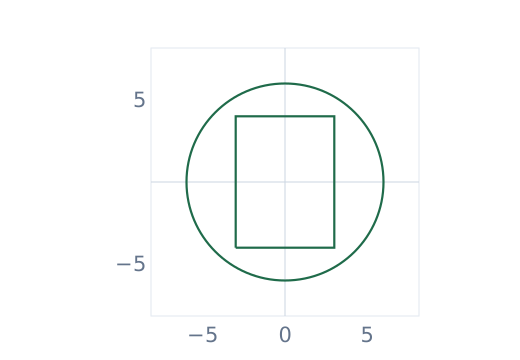
Q18. The circle C1 has equation x2 + y2 = 36. The circle C2 has radius 4, and its centre is equally likely to be anywhere in the rectangle −3 ≤ a ≤ 3, −4 ≤ b ≤ 4. What is the probability that the two circles meet?
Free · correct letter only
Answer
Answer: D. (48 − 4π)/48
The worked solution is part of the full bank. The question and the correct letter are free. Unlock the full bank
Q19. A jar contains n red beads, n blue beads, n green beads and n yellow beads, where n is an integer greater than 1. Two beads are taken at random, one after the other, without replacement. What is the probability that the two beads have different colours?
Free · correct letter only
Answer
Answer: C. 3n/(4n − 1)
The worked solution is part of the full bank. The question and the correct letter are free. Unlock the full bank
Q20. A bag contains 3 red counters and 4 blue counters. Two players draw counters from the bag in turn, one at a time, at random and without replacement. The first player to draw a red counter wins. What is the probability that the player who draws first wins?
Free · correct letter only
Answer
Answer: E. 22/35
The worked solution is part of the full bank. The question and the correct letter are free. Unlock the full bank
Q21. A biased coin lands heads with probability 2/3 on each flip, independently of other flips. It is flipped repeatedly and stops as soon as the last two flips are a head followed by a head (HH) or a tail followed by a head (TH). Ann wins if the flips stop with HH, and Ben wins if they stop with TH. What is the probability that Ann wins?
Free · correct letter only
Answer
Answer: A. 4/9
The worked solution is part of the full bank. The question and the correct letter are free. Unlock the full bank
Q22. Two fair six-sided dice are rolled. Given that at least one of them shows a 6, what is the probability that the total score is at least 10?
Free · correct letter only
Answer
Answer: E. 5/11
The worked solution is part of the full bank. The question and the correct letter are free. Unlock the full bank
Paper 2 questions
Paper 2 is Mathematical Reasoning. It can test this same topic. Argument, proof, and identifying errors are the topics that appear on Paper 2 only.
Q1. Fewer than half of the members of a club play tennis, but some do. A member is chosen at random, and then a member is chosen at random again, independently, so the same member may be chosen twice. Let P be the probability that exactly one of the two choices plays tennis, Q the probability that the first choice plays tennis, and R the probability that both choices play tennis. Which comparison is true?
Free · correct letter only
Answer
Answer: C. R < Q < P
The worked solution is part of the full bank. The question and the correct letter are free. Unlock the full bank
Q2. A bag contains r red balls and b blue balls, where r and b are positive integers. Two balls are taken at random without replacement. Which of the following conditions are necessary for the probability that the two balls have the same colour to equal 1/2? I: r + b is a perfect square. II: At least one of r and b is even. III: r and b differ by at least 2.
Free · correct letter only
Answer
Answer: E. I and III only
The worked solution is part of the full bank. The question and the correct letter are free. Unlock the full bank
Q3. Five books, Nile, Orla, Priya, Quinn and Sam, are placed in a row from left to right. Nile is to the left of Orla, Priya is to the left of Quinn, Quinn is to the left of Orla, Sam is to the left of Orla, and Nile is to the left of Sam. There are no ties in the order. How many such orders are there?
Free · correct letter only
Answer
Answer: B. 6
The worked solution is part of the full bank. The question and the correct letter are free. Unlock the full bank
Q4. A student is chosen at random from a class, with each student equally likely. Which of the following conditions are necessary for the probability that the chosen student plays chess to be exactly 3/7? I: the number of students in the class is a multiple of 7. II: the number who play chess is a multiple of 3. III: exactly 4 students do not play chess.
Free · correct letter only
Answer
Answer: D. I and II only
The worked solution is part of the full bank. The question and the correct letter are free. Unlock the full bank