
Question 1Geometry
TMUA Geometry — Practice Questions by Topic
These are SummitPapers original questions, not official past paper questions. Official TMUA questions sorted by topic are on TMUA past papers by topic.
- M5Geometry
- 40 questions18 on Paper 1 · 22 on Paper 2
- 8 free solutionsThe rest show the correct letter only
Covers: circles, sectors and polygons, similar figures, shortest paths, necessary and sufficient conditions for a quadrilateral.
What this topic tests
Geometry here means circles, sectors and polygons, similar figures, shortest paths, and a condition that is necessary or sufficient for a quadrilateral.
How it is assessed
This is Section 1, on both papers in this set. Each question has five options. A paper is 20 questions in 75 minutes, with no calculator.
This note is written for SummitPapers. The official list of what can be examined is the specification, together with the Notes on Mathematics and, for Paper 2, the Notes on Logic and Proof.
Key methods
Similar figures
Lengths scale by the similarity ratio, areas by its square, and volumes by its cube. An area ratio of 4 is a length ratio of 2, not of 4.
A shortest path
A straight line is the shortest path in the plane. On a net, or with a reflection, the straight line is drawn in the unfolded figure and then folded back.
Common mistakes
Scaling area like length
Doubling the lengths multiplies the area by 4. Using the length ratio on an area is the usual wrong option.
A necessary condition treated as enough
A quadrilateral with equal diagonals need not be a square. The question asks which condition forces the conclusion, not which condition the conclusion happens to have.
Worked example
This question is also in the list below, with the solution folded. It is opened here so the method is on the page before the other questions.
A circular sector of radius 12 has arc length 4π. A second circular sector of radius 6 has area 3π. Find the positive difference, in degrees, between their central angles.
Answer: B. 30°
Worked solution. For the first sector, 12θ1 = 4π, so θ1 = π/3, which is 60°. For the second, (1/2) × 62 × θ2 = 3π, so 18θ2 = 3π and θ2 = π/6, which is 30°. The positive difference is 60° − 30° = 30°.
Why the other options look right. A converts the radian difference π/6 using 90/π instead of 180/π, which gives 15°. C omits the factor 1/2 in the area formula, so the second angle is 15° and the difference is 45°. D reports the larger angle, 60°. E adds the two angles, 60° + 30° = 90°.
Paper 1 questions
Paper 1 is Applications of Mathematical Knowledge. Calculators are not allowed.
Q1. A circular sector of radius 12 has arc length 4π. A second circular sector of radius 6 has area 3π. Find the positive difference, in degrees, between their central angles.
Free · worked solution included
Answer and worked solution
Answer: B. 30°
Worked solution. For the first sector, 12θ1 = 4π, so θ1 = π/3, which is 60°. For the second, (1/2) × 62 × θ2 = 3π, so 18θ2 = 3π and θ2 = π/6, which is 30°. The positive difference is 60° − 30° = 30°.
Why the other options look right. A converts the radian difference π/6 using 90/π instead of 180/π, which gives 15°. C omits the factor 1/2 in the area formula, so the second angle is 15° and the difference is 45°. D reports the larger angle, 60°. E adds the two angles, 60° + 30° = 90°.
Q2. The incircle of triangle PQR touches QR at L, RP at M and PQ at N. Given that QL = 5, LR = 7 and PQ = 12, what is the perimeter of triangle PQR?
Free · worked solution included
Answer and worked solution
Answer: D. 38
Worked solution. The two tangent segments from a vertex to the points of contact are equal. From Q, QN = QL = 5. From R, RM = LR = 7. Then PN = PQ − QN = 12 − 5 = 7, and PM = PN = 7. Hence PR = PM + MR = 7 + 7 = 14 and QR = QL + LR = 12. The perimeter is 12 + 12 + 14 = 38.
Why the other options look right. A is 12 + 12 = 24, the two known sides with the third side omitted. B takes the third side to be the single tangent of length 7, giving 12 + 12 + 7 = 31. C treats the triangle as equilateral with side 12, giving perimeter 36. E adds the tangent QN = 5 to side QR as well, taking QR = 5 + 7 + 5 = 17, so the perimeter becomes 12 + 17 + 14 = 43.
Q3. Chords AB and CD of a circle meet at the point P inside the circle. AP = 5, PB = 8 and CD = 14, with CP < PD. What is PD?
Free · worked solution included
Answer and worked solution
Answer: E. 10
Worked solution. By the intersecting chords theorem, CP × PD = AP × PB = 5 × 8 = 40. Also CP + PD = CD = 14. So CP and PD are the roots of t² − 14t + 40 = 0, that is (t − 4)(t − 10) = 0. Since CP < PD, CP = 4 and PD = 10.
Why the other options look right. A divides AP × PB = 40 by CD = 14, as if PD × CD = 40. B gives the smaller root, which is CP. C assumes P is the midpoint of CD, so PD = 14/2. D assumes PD = PB, as if the two chords were symmetric about P.
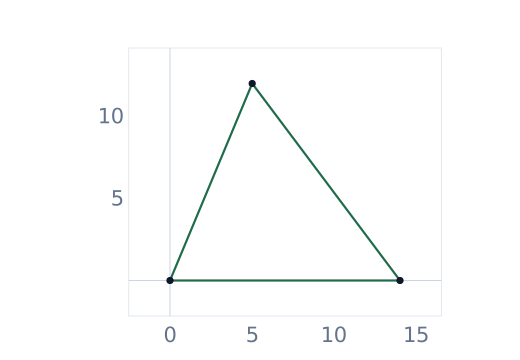
Q4. A triangle has vertices (0, 0), (14, 0) and (5, 12). What is the radius of its inscribed circle?
Free · worked solution included
Answer and worked solution
Answer: A. 4
Worked solution. The side lengths are 14, √(5² + 12²) = 13 and √(9² + 12²) = 15. The base is 14 and the height is 12, so the area is (1/2) × 14 × 12 = 84. The semi-perimeter is (13 + 14 + 15)/2 = 21. The inradius is the area divided by the semi-perimeter, which is 84/21 = 4.
Why the other options look right. B divides the area by the full perimeter, 84/42. C divides the area by the base, 84/14. D reports the height 12 of the triangle instead of the radius of the inscribed circle. E confuses the inscribed and circumscribed circles and computes abc/(4 × area) = (13 × 14 × 15)/336 = 65/8.
Q5. A circle of radius 1 rolls without slipping around the inside of a fixed circle of radius 3. Through what total angle, measured relative to the fixed circle, does the rolling circle turn while its centre goes once around the centre of the fixed circle?
Free · worked solution included
Answer and worked solution
Answer: B. 720°
Worked solution. Let O be the centre of the fixed circle and C the centre of the rolling circle, so OC = 3 − 1 = 2. Mark the point P of the rolling circle that starts at the point of contact. When OC has turned through an angle φ, the point of contact has moved along an arc of the fixed circle of length 3φ. With no slipping, the arc of the rolling circle from P to the new point of contact also has length 3φ, so the radius CP makes an angle 3φ with the direction from C to the point of contact. That direction is the direction of OC, at angle φ, so CP points at angle φ − 3φ = −2φ. Thus the rolling circle turns through 2φ, in the opposite sense to the motion of its centre. When the centre goes once around, φ = 360°, and the rolling circle turns through 720°.
Why the other options look right. A counts only the one revolution of the centre around O. C divides the circumference of the fixed circle, 6π, by the circumference of the rolling circle, 2π, getting 3 turns; this measures the turning relative to the moving line OC, not relative to the fixed circle. D uses the rule for rolling around the outside, (3 + 1)/1 = 4 turns. E inverts the ratio of the radii and uses 1/3 of a turn.
Q6. A circle has radius 10. Two parallel chords have lengths 12 and 16, and the chords lie on opposite sides of the centre. What is the distance between the two chords?
Free · worked solution included
Answer and worked solution
Answer: E. 14
Worked solution. The perpendicular from the centre to a chord bisects the chord. For the chord of length 12, the distance from the centre is √(10² − 6²) = 8. For the chord of length 16, it is √(10² − 8²) = 6. Because the chords are on opposite sides of the centre, their separation is the sum of these distances, 8 + 6 = 14.
Why the other options look right. A subtracts the two centre-to-chord distances, 8 − 6 = 2, as if the chords were on the same side of the centre. B gives only the distance from the centre to the chord of length 16. C gives only the distance from the centre to the chord of length 12. D gives the circle's radius rather than the distance between the chords.
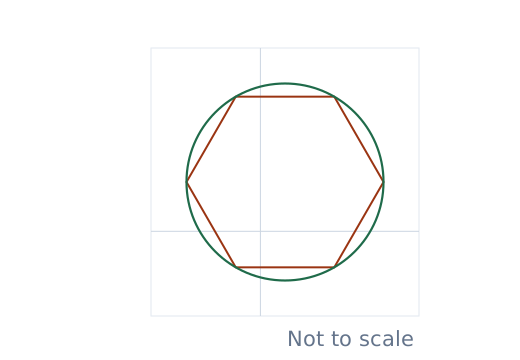
Q7. A circle has equation x2 + y2 − 2x − 4y − 11 = 0. A regular hexagon is drawn inside this circle so that every vertex of the hexagon lies on the circle. What is the area of the hexagon?
Free · correct letter only
Answer
Answer: D. 24√3
The worked solution is part of the full bank. The question and the correct letter are free. Unlock the full bank
Q8. Two similar circular sectors have radii r and r + 4, with r > 0. The shorter arc has length 12, and the areas of the sectors differ by 72. What is the positive difference of their perimeters?
Free · correct letter only
Answer
Answer: D. 20
The worked solution is part of the full bank. The question and the correct letter are free. Unlock the full bank
Q9. A circle has centre O and radius 2. Points P and Q lie on the circle, angle POQ is at least π/2, and triangle POQ has area 1. Point R is on the circle. What is the greatest possible area of triangle PRQ?
Free · correct letter only
Answer
Answer: A. 1 + √2 + √6
The worked solution is part of the full bank. The question and the correct letter are free. Unlock the full bank
Q10. A square has side length 12. A rectangle has one vertex on each side of the square and is symmetric across both diagonals of the square. The distance from a corner of the square to the rectangle’s vertex on a neighbouring side is t. What is the largest possible value of t if the rectangle has area 30?
Free · correct letter only
Answer
Answer: B. 6 + √21
The worked solution is part of the full bank. The question and the correct letter are free. Unlock the full bank
Q11. A prism has length h cm and its cross-section is a square of side 2x cm, with x > 2. The volume of the prism, in cm3, equals its total surface area, in cm2. Which expression equals h?
Free · correct letter only
Answer
Answer: B. 2x/(x − 2)
The worked solution is part of the full bank. The question and the correct letter are free. Unlock the full bank
Q12. A closed rectangular box has edge lengths 3y cm, y cm and 4y cm. Its volume, in cubic centimetres, is three times its surface area, in square centimetres. What is y?
Free · correct letter only
Answer
Answer: D. 19/2
The worked solution is part of the full bank. The question and the correct letter are free. Unlock the full bank
Q13. A circle passes through two adjacent vertices of a square and touches the side of the square opposite those two vertices. What is the ratio of the area of the circle to the area of the square?
Free · correct letter only
Answer
Answer: E. 25π/64
The worked solution is part of the full bank. The question and the correct letter are free. Unlock the full bank
Q14. A cube has edges of length 6 cm. What is the shortest distance, in centimetres, along the surface of the cube between two vertices that do not lie on a common face?
Free · correct letter only
Answer
Answer: C. 6√5
The worked solution is part of the full bank. The question and the correct letter are free. Unlock the full bank
Q15. A regular hexagon and a regular 12-sided polygon are both inscribed in a circle of radius 1. What is the area of the 12-sided polygon divided by the area of the hexagon?
Free · correct letter only
Answer
Answer: E. 2√3/3
The worked solution is part of the full bank. The question and the correct letter are free. Unlock the full bank
Q16. A cube has as its vertices the eight points whose coordinates are each 0 or 4. P is the midpoint of the edge from (0, 0, 0) to (4, 0, 0). Q is the midpoint of the edge from (0, 4, 4) to (4, 4, 4). What is the distance PQ?
Free · correct letter only
Answer
Answer: D. 4√2
The worked solution is part of the full bank. The question and the correct letter are free. Unlock the full bank
Q17. A circle of radius s is tangent to both positive axes. A circle of radius r > s is also tangent to both positive axes, and the two circles are tangent externally. What is r/s?
Free · correct letter only
Answer
Answer: A. 3 + 2√2
The worked solution is part of the full bank. The question and the correct letter are free. Unlock the full bank
Q18. Let S be the set of the eight points (x, y, z) whose coordinates are each 0 or 1. How many triangles with all three vertices in S have a right angle?
Free · correct letter only
Answer
Answer: C. 48
The worked solution is part of the full bank. The question and the correct letter are free. Unlock the full bank
Paper 2 questions
Paper 2 is Mathematical Reasoning. It can test this same topic. Argument, proof, and identifying errors are the topics that appear on Paper 2 only.
Q1. Triangles ABC and XYZ have equal perimeters. Consider these conditions. (1) AB = XY and BC = YZ. (2) AB = XY and angle ACB = angle XZY. (3) Angle ABC = angle XYZ. Which conditions are enough to guarantee that the triangles are congruent?
Free · worked solution included
Answer and worked solution
Answer: C. (1) and (2) only
Worked solution. Condition (1): equal perimeters then force CA = ZX, so the triangles are congruent by SSS. Condition (2): let c = AB = XY, let C be the equal angle and let s = BC + CA, which equals YZ + ZX because the perimeters and c agree. The cosine rule gives c² = a² + b² − 2ab cos C = (a + b)² − 2ab(1 + cos C), so ab = (s² − c²)/(2(1 + cos C)) is the same for both triangles. The other two sides are the roots of t² − st + ab = 0, so all three side lengths match and SSS gives congruence. Condition (3): a 3, 4, 5 triangle and an isosceles right-angled triangle with legs 6(2 − √2) both have a right angle at B and perimeter 12, but they are not congruent. The conditions that are enough are (1) and (2) only.
Why the other options look right. A rejects (2), but with c and angle C fixed, equal perimeters fix a + b and the cosine rule then fixes ab, so the sides match. B rejects (1), but with AB = XY and BC = YZ the equal perimeters force CA = ZX, so the triangles are congruent by SSS. D rejects (2) and accepts (3), but one equal angle is not enough: the 3, 4, 5 triangle and the isosceles right-angled triangle with perimeter 12 differ. E accepts (3), which that same pair of triangles rules out.
Q2. In trapezium PQRS the sides PQ and SR are parallel, with PQ = 15 and SR = 5. The diagonals meet at X. The line through X parallel to PQ and SR meets the non-parallel sides of the trapezium. How long is the segment of that line inside the trapezium?
Free · worked solution included
Answer and worked solution
Answer: E. 15/2
Worked solution. The diagonals of a trapezium divide each other in the ratio of the parallel sides. Here that ratio is 5:15 = 1:3, and the shorter part lies next to SR. Along the height, X is 1 part of the way from SR toward PQ out of 4 parts. A line parallel to the bases has length changing linearly between them, so the length at X is 5 + (1/4)(15 − 5) = 15/2.
Why the other options look right. A is 15/4, only the part of the segment from one non-parallel side to X; X bisects the segment, so each part is 15/4 and the whole is 15/2. B is 10 = (5 + 15)/2, the mid-line length, which assumes X lies halfway between the parallel sides. C uses the ratio 1/3 itself as the fraction of the height, giving 5 + 10/3 = 25/3; the piece from the shorter base is one part out of four, not one out of three. D is √(5 × 15) = 5√3, the length of the parallel segment that splits the trapezium into two similar trapezia; it confuses that segment with the one through X, whose length is the harmonic mean 2 × 5 × 15/(5 + 15) = 15/2.
Q3. A solid is built from unit cubes on a 3 by 3 grid. In the plan, the whole front row is occupied, and so are the left-hand cells of the middle row and the back row. No other cells are occupied. The front elevation gives maximum heights 4, 1 and 2 from left to right. The side elevation, read from the right with the front on the left, gives maximum heights 2, 4 and 3 from front to back. What are the possible numbers of cubes?
Free · correct letter only
Answer
Answer: D. 11 or 12
The worked solution is part of the full bank. The question and the correct letter are free. Unlock the full bank
Q4. The interior angle of a regular n-sided polygon is two thirds of the interior angle of a regular m-sided polygon, where n and m are integers with n ≥ 3 and m ≥ 3. How many such pairs (n, m) are there?
Free · correct letter only
Answer
Answer: E. 3
The worked solution is part of the full bank. The question and the correct letter are free. Unlock the full bank
Q5. The diagonals of a quadrilateral are perpendicular, and their lengths are 6 and 8. The midpoints of the four sides are joined in order to form a second quadrilateral. What is the area of this second quadrilateral?
Free · correct letter only
Answer
Answer: B. 12
The worked solution is part of the full bank. The question and the correct letter are free. Unlock the full bank
Q6. WXYZ is a quadrilateral, labelled anticlockwise. Which one of the following is necessary but not sufficient for WXYZ to be a rhombus?
Free · correct letter only
Answer
Answer: B. The diagonals WY and XZ are perpendicular
The worked solution is part of the full bank. The question and the correct letter are free. Unlock the full bank
Q7. Two chords PQ and RS of a circle cross at right angles at the point X. PX = 2, XQ = 6 and RX = 3. What is the radius of the circle?
Free · correct letter only
Answer
Answer: B. √65/2
The worked solution is part of the full bank. The question and the correct letter are free. Unlock the full bank
Q8. A student chooses a real number x with 0 < x < 1 and attempts to draw a triangle PQR with angle P equal to 30°, side QR equal to x and side PR equal to 1. Congruent triangles are regarded as the same. Which statements are correct? I: For some x there is exactly one such triangle. II: For some x there are exactly two different such triangles. III: For some x there are exactly three different such triangles.
Free · correct letter only
Answer
Answer: E. I and II only
The worked solution is part of the full bank. The question and the correct letter are free. Unlock the full bank
Q9. A polygon with n ≥ 3 vertices lies on a circle, and all its interior angles are equal. For which n must the polygon be regular?
Free · correct letter only
Answer
Answer: C. for every odd n
The worked solution is part of the full bank. The question and the correct letter are free. Unlock the full bank
Q10. A student draws a triangle that is not equilateral. For each side, the student checks whether the perpendicular bisector of that side passes through the opposite vertex. Which of these statements are true? I: The triangle can have exactly 1 such side. II: The triangle can have exactly 2 such sides. III: The triangle can have exactly 3 such sides.
Free · correct letter only
Answer
Answer: C. I only
The worked solution is part of the full bank. The question and the correct letter are free. Unlock the full bank
Q11. The circle x² + y² − 6x + 8y − 11 = 0 is inscribed in a regular hexagon, so that every side of the hexagon touches the circle. What is the area of the hexagon?
Free · correct letter only
Answer
Answer: D. 72√3
The worked solution is part of the full bank. The question and the correct letter are free. Unlock the full bank
Q12. Among all rectangles of perimeter 28 that have one side of length at most 5, what is the greatest possible area?
Free · correct letter only
Answer
Answer: B. 45
The worked solution is part of the full bank. The question and the correct letter are free. Unlock the full bank
Q13. Into how many regions do the circle x² + y² = 25 and the two coordinate axes divide the plane?
Free · correct letter only
Answer
Answer: D. 8
The worked solution is part of the full bank. The question and the correct letter are free. Unlock the full bank
Q14. A rectangle has area 81. What is the least possible perimeter of the rectangle?
Free · correct letter only
Answer
Answer: C. 36
The worked solution is part of the full bank. The question and the correct letter are free. Unlock the full bank
Q15. A rectangular pen is built against a long straight wall, so fencing is needed on only three of its sides. With 36 m of fencing, what is the greatest possible area of the pen, in m²?
Free · correct letter only
Answer
Answer: A. 162
The worked solution is part of the full bank. The question and the correct letter are free. Unlock the full bank
Q16. A rectangle has diagonals of length 10. What is the greatest possible area of the rectangle?
Free · correct letter only
Answer
Answer: C. 50
The worked solution is part of the full bank. The question and the correct letter are free. Unlock the full bank
Q17. Into how many regions do the circle x² + y² = 9 and the parabola y = x² − 3 divide the plane?
Free · correct letter only
Answer
Answer: A. 5
The worked solution is part of the full bank. The question and the correct letter are free. Unlock the full bank
Q18. A rectangle has perimeter 24 and one of its sides is at least 8 long. What is the greatest possible area?
Free · correct letter only
Answer
Answer: B. 32
The worked solution is part of the full bank. The question and the correct letter are free. Unlock the full bank
Q19. The parabola y = x² and the line y = 2x − 1 divide the plane into how many regions?
Free · correct letter only
Answer
Answer: D. 4
The worked solution is part of the full bank. The question and the correct letter are free. Unlock the full bank
Q20. The points M(1, 3) and N(7, 5) are given, and P is a point on the x-axis. What is the least possible value of MP + PN?
Free · correct letter only
Answer
Answer: E. 10
The worked solution is part of the full bank. The question and the correct letter are free. Unlock the full bank
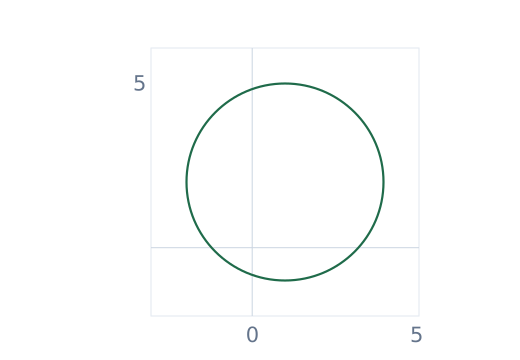
Q21. A regular octagon is drawn around the circle x2 + y2 − 2x − 4y − 4 = 0 so that each of its eight sides touches the circle. What is the area of the octagon?
Free · correct letter only
Answer
Answer: D. 72(√2 − 1)
The worked solution is part of the full bank. The question and the correct letter are free. Unlock the full bank
Q22. P, Q and R are vertices of a regular n-sided polygon, n ≥ 3, and O is the centre. Angle POQ is 2π/5 and angle QOR is π/3. Then n must be a multiple of k. What is the largest such k?
Free · correct letter only
Answer
Answer: C. 30
The worked solution is part of the full bank. The question and the correct letter are free. Unlock the full bank